Didier Stevens

Monday 29 March 2010

Escape From PDF

Filed under: Hacking,PDF — Didier Stevens @ 19:46

This is a special PDF hack: I managed to make a PoC PDF to execute an embedded executable without exploiting any vulnerability!

I use a launch action triggered by the opening of my PoC PDF. With Adobe Reader, the user gets a warning asking for approval to launch the action, but I can (partially) control the message displayed by the dialog. Foxit Reader displays no warning at all, the action gets executed without user interaction.

PDF viewers like Adobe Reader and Foxit Reader don’t allow embedded executables (like binaries and scripts) to be extracted and executed:
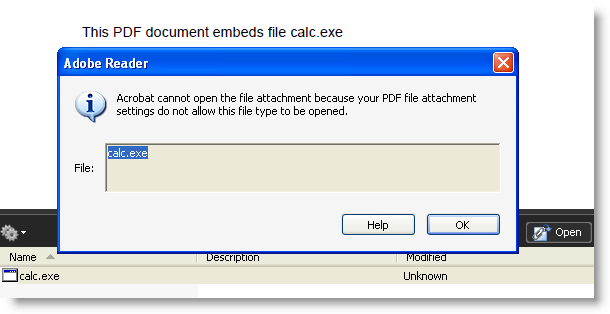
But I found another way to launch a command (/Launch /Action), and ultimately run an executable I embedded using a special technique. With Adobe Reader, a launch action needs to be approved by the user:
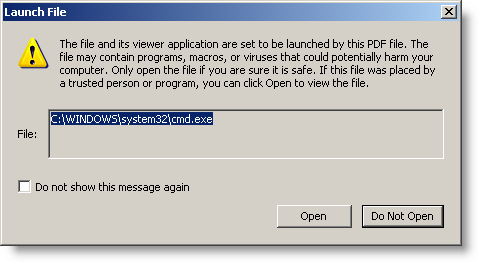
But I can partially control the message displayed by this dialog box:
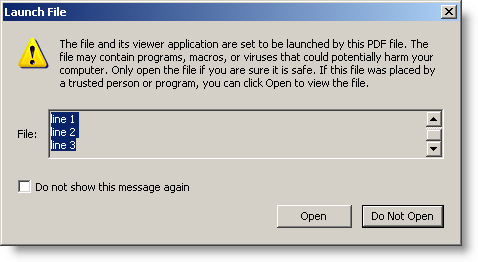
I can use this to social-engineer users to “Open” the file:
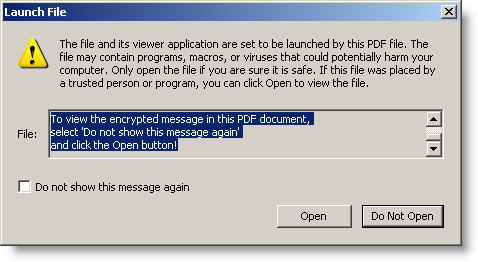
Do you believe this could this mislead some of your users? Or maybe you can come up with a better message to fool your users.

With Foxit Reader, no warning is displayed:
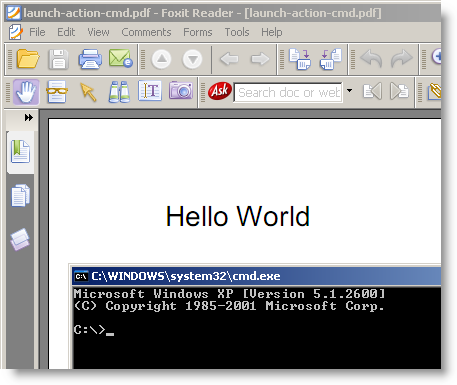
I’m not publishing my PoC PDF yet, but you can download a PDF that will just launch cmd.exe here. Use it to test your PDF reader.

With Adobe Reader, the only thing preventing execution is a warning. Disabling JavaScript will not prevent this (I don’t use JavaScript in my PoC PDF), and patching Adobe Reader isn’t possible (I’m not exploiting a vulnerability, just being creative with the PDF language specs).

I shared my PoC with Adobe’s PSIRT. Maybe they will come up with a solution to prevent this, should they consider that the protection offered by the warning dialog is not sufficient. BTW, preventing Adobe Reader from creating new processes blocks this trick.

In this case, Foxit Reader is probably worse than Adobe Reader, because no warning gets displayed to prevent the launch action. My PoC PDF requires some changes for Foxit Reader, because ultimately, the executable doesn’t run. But that’s probably due to some variation in the PDF language supported by Foxit Reader.

Tested with Adobe Reader 9.3.1 on Windows XP SP3 and Windows 7.

Wednesday 17 March 2010

Tweet Shellcode

Filed under: My Software,Shellcode — Didier Stevens @ 21:33

As its name implies: shellcode to send a Twitter update.

Tuesday 9 March 2010

Frisky Solitaire – Another Info Stealer

Filed under: Forensics,Malware — Didier Stevens @ 0:00

Marcus Murray gave a great talk at TechEd Berlin 2009: “Hack-Proofing Your Clients Using Windows 7 Security”. In one of his demos, he showed a trojaned Excel spreadsheet. The spreadsheet was a simple text-based game, but it had a malicious component that executed surreptitiously while the game was played.

As I’ve done several hacks with Excel macros in the past, this made me realize that social engineering is a key element to get people to run macros from a spreadsheet of unknown origin.

Several people have asked me about de details of the vulnerability I exploited in my PDF Info Stealer PoC. But that’s not important. It’s not about the exploit, it’s about the payload: the info stealer. As I’ve written in my previous post, I don’t even need an exploit to get users to execute the info stealer. If I put the info stealer inside an Excel spreadsheet and social engineer the targeted users to execute the macros, I’ve achieved my goal without exploiting a software vulnerability.

I present you Frisky Solitaire:

Frisky solitaire is more compelling than text-based Excel games, because of the graphics. I took Solitaire from ReactOS, turned it into a DLL and embedded it with my memory loading shellcode into Excel macros (the same technique as I developed for cmd.dll and regedit.dll). I imagine that a simple game like Solitaire in Excel can go viral inside a company, when you know that many corporations disable standard Windows games on their desktops and Terminal Servers.

But in a crude attempt at social engineering the male population of a targeted company, I added an element of nudity to the game. The implied message of the game’s title is that winning games increases nudity. I know, I’m talking about basic instincts here, but it still does the trick…

So I imagine that this game can become popular with a large part of the male employees of a targeted company. And that they wouldn’t question the fact you have to execute Excel macros to play a game. Sounds plausible, no?

Of course, you guessed it: Frisky Solitaire is trojaned with an info stealer… No need to exploit a software vulnerability to steal info. Given that here too, everything is done in memory, detection is unlikely.

Monday 8 March 2010

PDF Info Stealer PoC

Filed under: Forensics,Malware,PDF — Didier Stevens @ 0:00

An info stealer is malware that steals credentials or files from its victims.

Info stealers don’t require admin rights to perform their task, and can be designed to evade or bypass AV, HIPS, DLP and other security software.

I helped out a friend testing his environment with a PoC PDF info stealer I designed (I will not publish it).

This PDF document exploits a known vulnerability, and executes shellcode to load a DLL (embedded inside the PDF document) from memory into memory. This way, nothing gets written to disk (except the PDF file). The DLL searches the My Documents folder of the currect user for a file called budget.xls, and uploads it to Pastebin.com.

My PDF info stealer was succesful: file budget.xls was posted to Pastebin.com

Preventing an info stealer from operating is not easy. The Windows operating system is designed to give user processes unrestricted access to the user’s data. It’s only starting with the Windows Vista kernel and Windows Integrity Control that a process can be assigned a lower level than user data and be restricted from accessing it. Lowering the Integrity Level of Acrobat Reader will help us in this case, but if I exploit an Excel vulnerability (or just use macros, without exploiting a vulnerability), the integrity levels will not protect us.

Neither is preventing data egress easy. OK, you can decide to block Pastebin.com. But can you block all sites that can be posted to? Like Wikipedia? And if you can, do you block ICMP packets?

To protect confidential data, don’t let it be accessed by systems with Internet access. That’s not very practical, but it’s reliable. Or use strong encryption with strong passwords (not the default RC4 Excel encryption). The info stealer will have the extra difficulty to steal the password too.

I know this is obvious advice, but it’s not easy protecting data from carefully designed info stealers on Windows.

Monday 1 March 2010

Quickpost: NetworkMashup.xls

Filed under: My Software,Quickpost — Didier Stevens @ 6:11

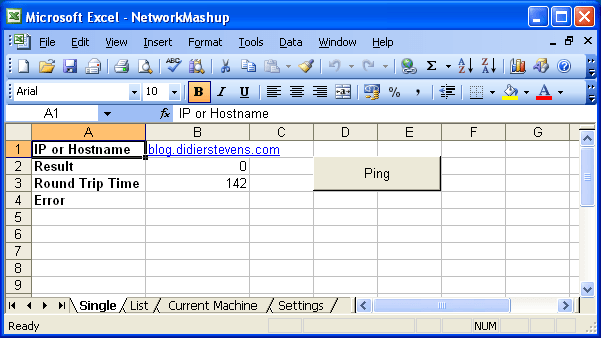
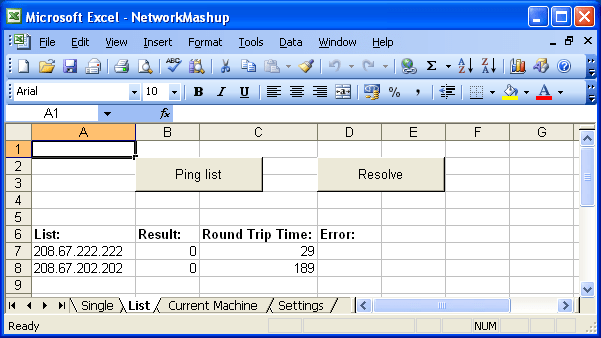
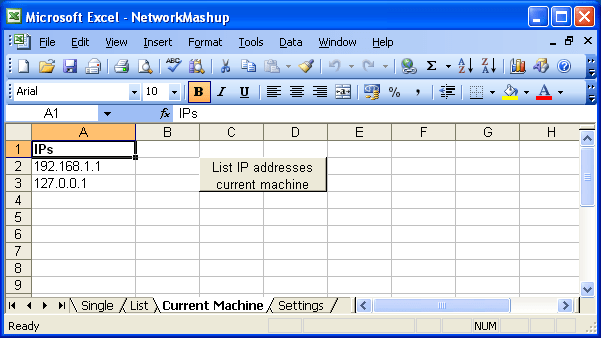
NetworkMashup.xls is a spreadsheet with VBA macros I scraped from the Internet to execute pings and name/address resolution from within Excel with WIN32 API calls.

Not only is it handy when you need to do some network mapping in a restricted environment, but also if you’ve just a list of machines to monitor.

The spreadsheet contains several sheets. One sheet to perform a single ping:

One sheet to ping/resolve a list:

One sheet to list the IP addresses of the current machine:

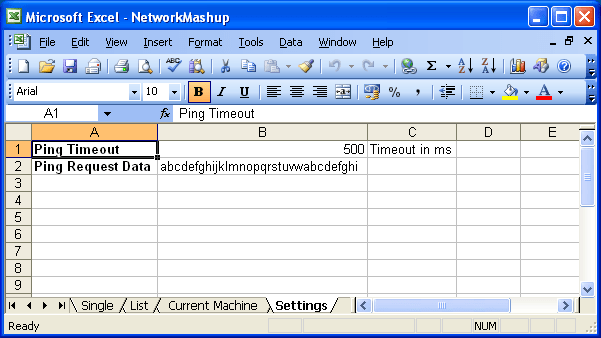
And last, a sheet with settings:

Download here.


Quickpost info


Monday 22 February 2010

Ping Shellcode

Filed under: My Software,Shellcode — Didier Stevens @ 10:26

I’ve added 2 new assembly source files for shellcode to execute a ping.

First one does a simple ping, second one does a ping with the computername and username in the ICMP packet data.

Tuesday 16 February 2010

MemoryLoadLibrary: From C Program to Shellcode

Filed under: Hacking,My Software,Shellcode — Didier Stevens @ 0:40

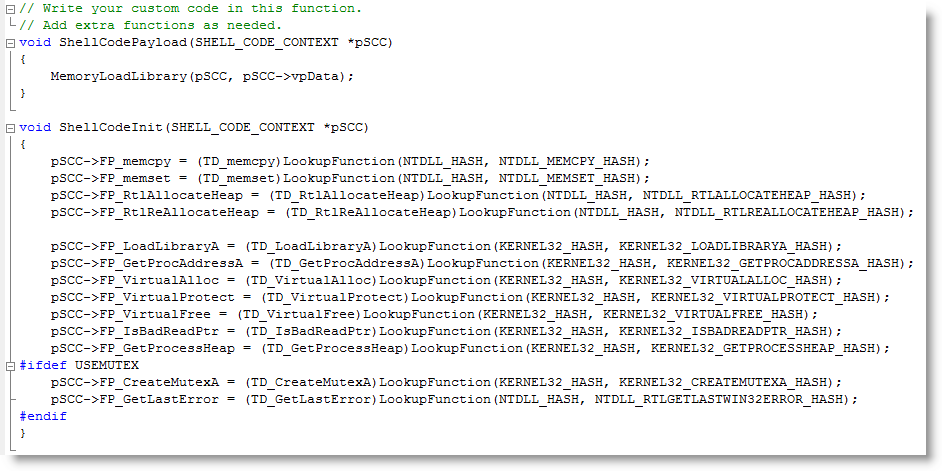
The DLL-loading shellcode I used in my cmd.xls spreadsheet was generated with a method I worked out to generate WIN32 shellcode with a C-compiler. You can find it on my new Shellcode page.

With this release, I provide you with all the tools you need to build your own version of cmd.xls:

Monday 8 February 2010

Excel with cmd.dll & regedit.dll

Filed under: Hacking,My Software — Didier Stevens @ 21:17

I modified the source code of ReactOS‘ cmd and regedit for the following trick:

Let me summarize how I did this, as this is the combined result of several techniques I blogged about before.

You can download regedit.dll here and the new version of cmd.dll with the DLL command here. The DLL command I added allows you to load a DLL with LoadLibrary or directly into memory (/m option). When loaded with LoadLibrary, the library will be unloaded with FreeLibrary unless you use option /k to keep it loaded.

The DLL command assumes that your DLLs execute via the DllMain entry-point when they get loaded.

Thursday 4 February 2010

cmd.dll

Filed under: Hacking,My Software — Didier Stevens @ 1:16

This is something I’ve wanted to do for some time: take a command interpreter and transform it from an EXE into a DLL.

Why you ask? Well, because it’s a fun challenge 😉

But also because a DLL is loaded into a process. In a restricted environment, it can be injected into a legitimate process and thus bypass the restriction mechanisms.

Metasploit’s Meterpreter is another example of a command interpreter in DLL form.

cmd.exe from Microsoft is closed source, but there is an open-source variant available from the ReactOS project.

Compiling cmd.exe from ReactOS is simple: download the source-code and the ReactOS build environment. Install it, start the build environment  and issue command make cmd. That’s all you need to do to compile cmd.exe (I used version 0.3.11).

Transforming the source code to generate a DLL in stead of an EXE is simple. You need to change 3 files.

Edit file cmd.rbuild and make these changes to the module element:

<module name="cmd" type="win32dll" installbase="system32" installname="cmd.dll" unicode="yes" crt="msvcrt">

Because I want to use this DLL in GUI-processes without console, I need to create a console. Edit file cmd.c and add AllocConsole(); to function cmd_main:

SetFileApisToOEM();
InputCodePage= 0;
OutputCodePage = 0;

AllocConsole();

hConsole = CreateFile(_T("CONOUT$"), GENERIC_READ|GENERIC_WRITE,
 FILE_SHARE_READ|FILE_SHARE_WRITE, NULL,
 OPEN_EXISTING, 0, NULL);

And because a DLL has another entry-function than an EXE, edit file main.c and replace function main with function DllMain:

#include <precomp.h>

INT WINAPI
DllMain(
 IN PVOID hInstanceDll,
 IN ULONG dwReason,
 IN PVOID reserved)
{
 switch (dwReason)
 {
 case DLL_PROCESS_ATTACH:
 cmd_main(0, NULL);
 break;

 case DLL_THREAD_ATTACH:
 break;

 case DLL_THREAD_DETACH:
 break;

 case DLL_PROCESS_DETACH:
 break;
 }

 return TRUE;
}

That’s it. Recompile with make cmd to generate cmd.dll

There are still some improvements we can make, but that’s for a later version: error messages are not displayed, exiting the shell terminates the host process, …

You can download the modified source files and compiled cmd.dll here.

This is a screenshot of cmd.dll injected inside Excel with my memory module shellcode:

Tuesday 2 February 2010

Quickpost: Quasi-Tautologies & SQL-Injection

Filed under: Hacking,Quickpost — Didier Stevens @ 9:54

Last OWASP/ISSA Belgian chapter meeting was the location of an interesting discussion. For a full report of the meeting, read Xavier’s excellent blogpost.

Many SQL-injection techniques rely on tautologies: adding an expression that is always true to the where-clause of a select statement. Like OR 1=1. 1=1 is a tautology, it’s an expression that always yields true.

So if SELECT * FROM USERS WHERE USERNAME = ‘ADMIN’ and PASSWORD = ‘UNKNOWN’ doesn’t select any rows because the password is not correct, injecting ‘ OR 1=1 — gives SQL statement SELECT * FROM USERS WHERE USERNAME = ‘ADMIN’ and PASSWORD = ” OR 1=1 –‘ which will return all rows, because the where-clause is always true (OR 1=1).

There are several security applications (WAFs, SQL firewalls, …) designed to monitor the stream of SQL statements and reject statements with tautologies, i.e. the result of a SQL-injection. Some are very simple and just try to match pattern 1=1. Bypassing them is easy: 1>0 is also a tautology. Others are more sophisticated and try to find constant expressions in the where-clause. Constant expressions are expressions with operators, functions and constants, but without variables. If a constant expression is detected that always evaluates to true, the firewall assumes it’s the result of a SQL-injection and blocks the query.

This is all classic SQL-injection, but now comes the interesting part.

What if I use an expression that is not a tautology in it’s mathematical sense, but is almost one… Say I use expression RAND() > 0.01 ? The RAND function is a random number generator and returns a floating point value in the range [0.0, 1.0[. Expression RAND() > 0.01 is not a tautology, it’s not always true, but it is true about 99% percent of the time. I call this a quasi-tautology.

A firewall looking for tautologies will not detect this, because it is not a tautology. But when you use it in a SQL-injection, you stand a 99% chance of being succesful (provided the application is vulnerable to SQL-injection)!

There are other functions than RAND to create quasi-tautologies. An expression comparing the seconds of the current system time with 59 is also a quasi-tautology.

The GreenSQL firewall will detect SQL statements with quasi-tautologies, not because it looks for them, but because it builds a whitelist in training mode.


Quickpost info


« Previous PageNext Page »

Blog at WordPress.com.