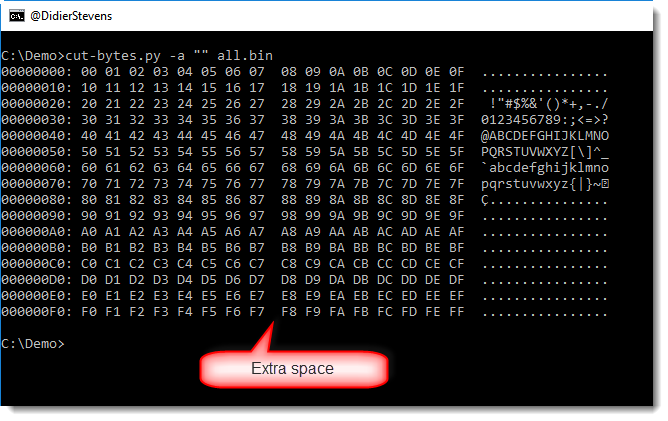
This new version of cut-bytes.py brings a small cosmetic change to the way a hex/ASCII dump is displayed:
An extra space is added between the 8th and 9th byte of the hexdump. This was suggested to me by an attendee of the last private training I gave. cut-bytes_V0_0_6.zip (https)
MD5: 7F726219F6F601018B4BD39E9A407728
SHA256: BFD80EF00455CD938A05A18EAA33551ABEC6B0298A0AEE81052E6F5A12BB86F7
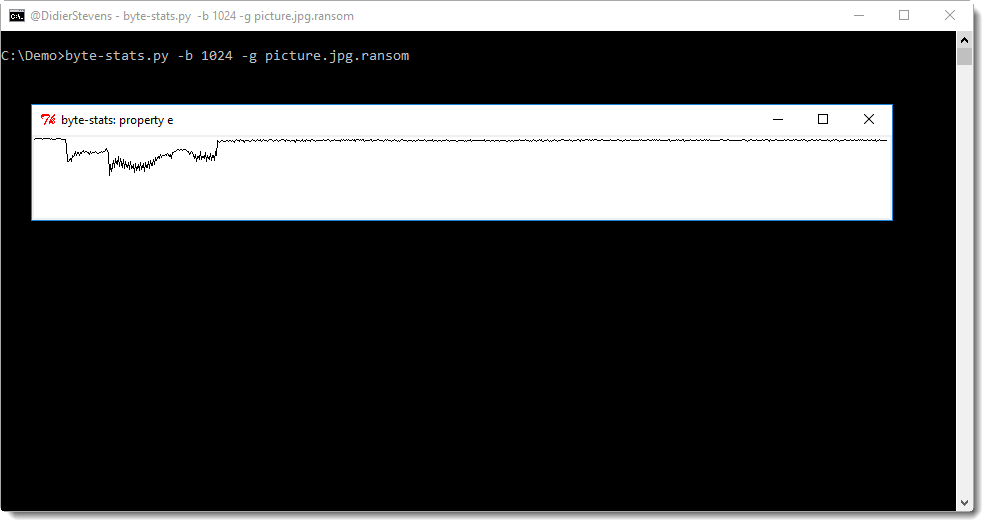
My tool byte-stats.py calculates statistics for the files it analyzes. With option -l (and -p) , it produces a list of values for different parts of the file (buckets), for example a list of entropy values. With this, one can have an idea how the entropy changes inside a file.
But as the saying goes, a picture is worth a thousand words, so I added option -g to produce a very simple graph of these values (just a line, no axis or scale). This does not require any extra Python module, I use Python’s TkInter module, the standard GUI for Python.
Metasploit has a module to create Microsoft Word document with macros (.docm): office_word_macro.
Documents generated with this module are not that hard to analyze and detect, because they always use the same VBA code. As I explain in my workshops and trainings, although the “new” Office file format (OOXML) is a ZIP container for XML files, VBA code is still stored inside a binary file (vbaProject.bin) using the “old” file format (Compound File Binary Format, or ole file as I like to call it). This Metasploit module always uses the same vbaProject.bin file (inside the template file), and I explain how to analyze and detect it in this video:
I show YARA rules and ClamAV signatures in this video to detect documents created with this Metasploit module.
Here are the YARA rules:
/*
  Version 0.0.1 2017/08/20
  Source code put in public domain by Didier Stevens, no Copyright
  https://DidierStevens.com
  Use at your own risk

  History:
    2017/08/20: start
*/

import "hash"

rule metasploit_office_word_macro_ID_GUID {

    meta:
        description = "Detect Metasploit's office_word_macro unique GUID"

    strings:
        $ID = "ID=\"{BB64F33D-3617-FA44-AFC9-63F65314A8A3}\""

    condition:
        $ID
}

rule metasploit_office_word_macro_vbaproject_bin_zipped {
    meta:
        description = "Detect .docm files created with Metasploit's office_word_macro exploit"

    strings:
        $a = {776F72642F76626150726F6A6563742E62696EED3B0D7853D775E75D3D0959B6B1640C7120908B4CB04C2421C9B22D3B98EADF86D860B0032421C1FA79C222B2A44A4FD8E4A795B1D3928435AC5D33CAD20E42DAA62DEB489AB07EE9BA8976FB42F3B5DF48D3ED4BBA7531C99666FDBE0E4AB32F69B6C43BF7BD275BFE2350BA}

    condition:
        $a and hash.md5(@a + 19, 5962) == "e5995aba8551f30cc15c87ee49fb834a"
}
The first rule (metasploit_office_word_macro_ID_GUID) detects the vbaProject.bin file used by this Metasploit module based on the unique ID ({BB64F33D-3617-FA44-AFC9-63F65314A8A3}) stored inside stream PROJECTwm of file vbaProject.bin. This rule must be used with a tool that can scan inside ZIP files, like zipdump.py or ClamAV.
If you can’t use such a tool, you can still use the second rule (metasploit_office_word_macro_vbaproject_bin_zipped) with the standard YARA scanner: this rule looks for the datastream of the compressed vbaProject.bin file inside Office files.
Here are the ClamAV signatures:
Signature to be put inside a .ndb file:
metasploit_office_word_macro_ID_GUID:0:*:49443D227B42423634463333442D333631372D464134342D414643392D3633463635333134413841337D22
Signature to be put inside a .hdb file:
1788454ae206101fa6febf99005ce03b:15872:metasploit_office_word_macro_vbaproject_bin
The first signature (metasploit_office_word_macro_ID_GUID) detects the unique ID (just like the first YARA rule), and the second signature (metasploit_office_word_macro_vbaproject_bin) detects the vbaProject.bin file based on the MD5 hash (1788454ae206101fa6febf99005ce03b).
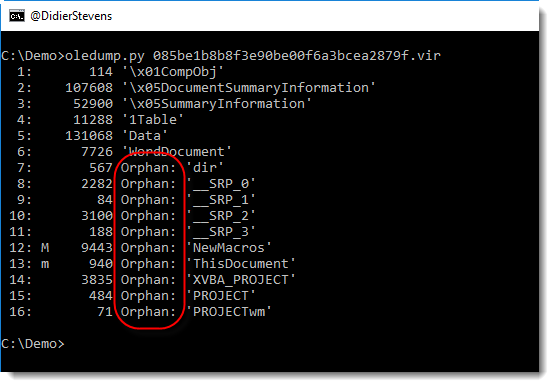
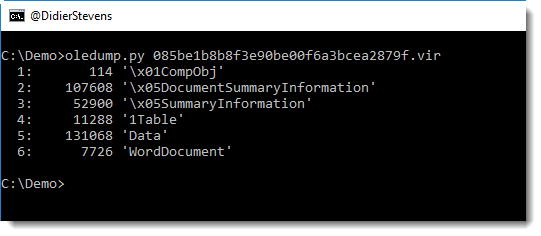
I’ve seen this once before: this is a malicious document that has been cleaned by an anti-virus program. The macros have been disabled by orphaning the streams containing macros, just like when a file is deleted from a filesystem, it’s the index that is deleted but not the content. FYI: olevba will find macros.
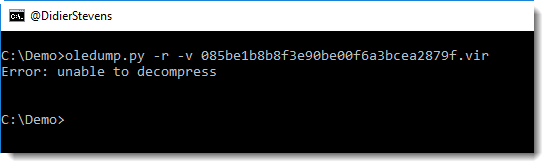
Using the raw option, it’s possible to extract the macros:
I regularly get ideas to improve my tools when I give (private) training, and last week was not different.
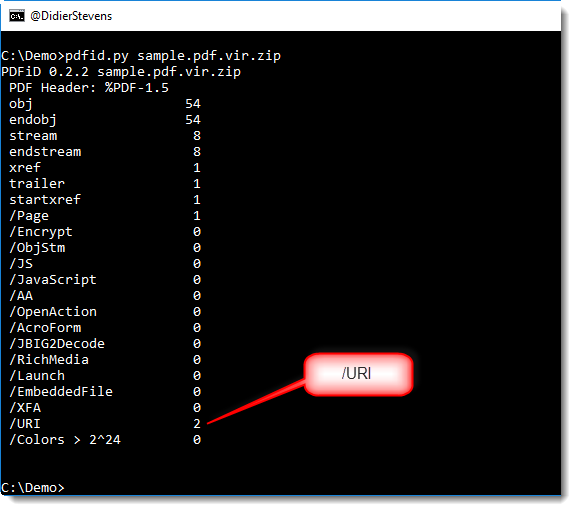
This new version of pdfid.py adds a /URI counter, to help identify PDF documents with embedded URLs, used for phishing or social-engineering users into clicking on links.
I did not hardcode this new counter into the source code of pdfid.py, but it is listed in a new config file: pdfid.ini. You too can add your own identifiers to this configuration file.



 Didier Stevens