Didier Stevens

Thursday 13 July 2017

Analyzing ClamAV Signatures – Correction

Filed under: Malware — Didier Stevens @ 23:26

My previous blog post “Analyzing ClamAV Signatures” is incorrect. Here is a better explanation.

I wrongly assumed that the signature printed in the debug statement would be the actual signature in the ClamAV database. That is not always the case.

So here is a better method.

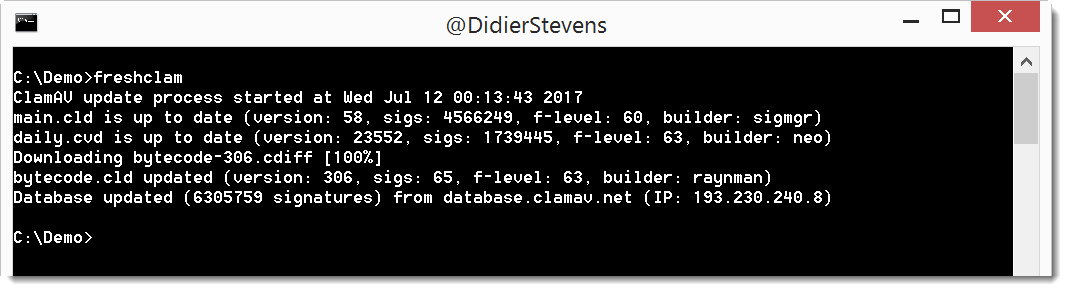
First I update the signatures (yup, that’s ClamAV on Windows):

This is a standard scan:

The signature is Win.Trojan.Mimikatz-6331391-0.

Then I do a search with sigtool in the database, providing a regular expression (Mimikatz-6331391) to match signature names (this matching process is case sensitive):
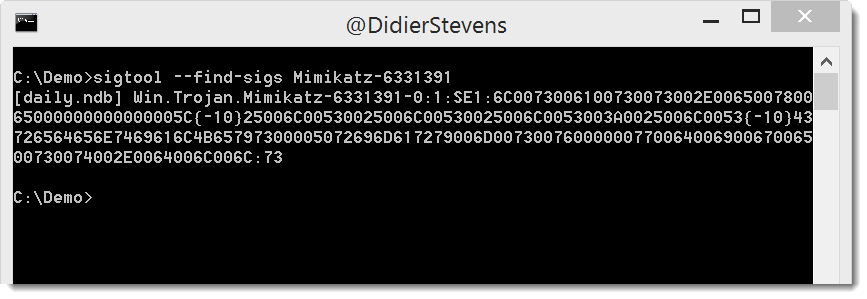
And this signature is more interesting. This is an extended signature. It is composed of several fields (: is the separator). Here I have each field on a separate line:

Field 1 is the name of the signature.

Field 2 is the type of file to scan: 1 is for PE files

Field 3 is the part of the file to scan: SE1 is the second section of the PE file.

Field 4 is the hex signature: the sequence of bytes to search for in the section, expressed as hexadecimal data. {-10} is a wildcard for 0 to 10 arbitrary bytes.

Field 5 is the minimum version of the ClamAV engine that supports this type of signature.

The bytes represent strings (UNICODE and ASCII):

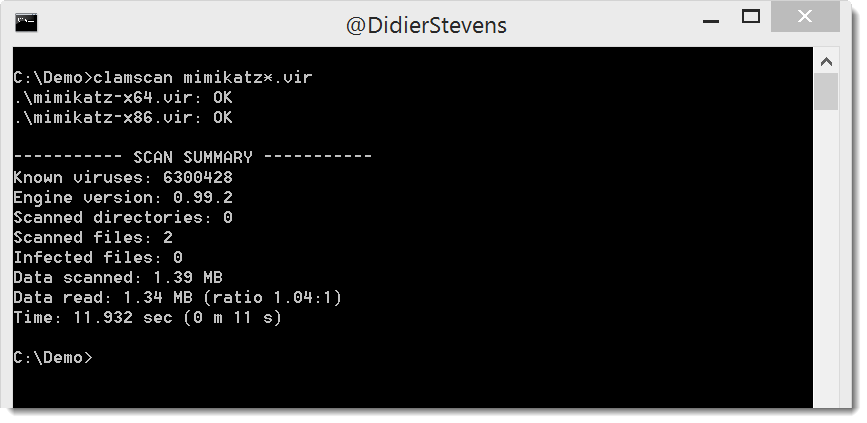
This signature does not trigger on the genuine mimikatz binaries:
Wednesday 12 July 2017

Analyzing ClamAV Signatures

Filed under: Malware — Didier Stevens @ 0:00

While updating my Petya/Notpetya notes, I saw that ClamAV now detects resources 1 and 2 (zlib compressed PE files) as Mimikatz. Curious about how they detect Mimikatz, I wanted to take a look at the signature. I’ve done this before, but I forgot exactly how. So here is a blog post to remind me next time.

First I update the signatures (yup, that’s ClamAV on Windows):

This is a standard scan:

The signature is Win.Trojan.Mimikatz-6331391-0.

Then I do a scan with option –debug, this will print out the signature:

The signature is: 2813d34f6197eb4df42c886ec7f234a1:47616:Win.Trojan.Mimikatz-6331391-0

I hoped for something more interesting: this is an MD5 hash-based signature. 2813d34f6197eb4df42c886ec7f234a1 is the MD5 hash of the file, 47616 is its file size, and Win.Trojan.Mimikatz-6331391-0 is the signature name.


Tuesday 11 July 2017

Update: zipdump.py Version 0.0.10

Filed under: My Software,Update — Didier Stevens @ 19:17

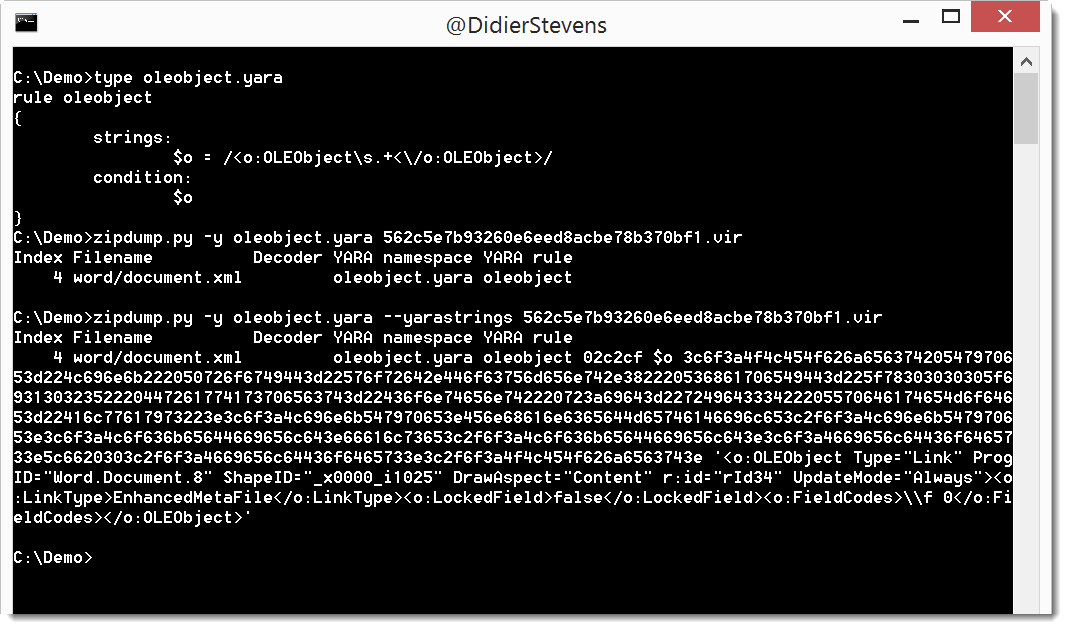
I regularly use YARA rules with my tools. Option -y starts the YARA engine, and option –yarastrings gives an overview of the matched strings, like this:

But it’s too much information when I use regular expressions in my YARA rules to match, for example, XML elements.

I added option –yarastringsraw to zipdump to view just the matched string, and nothing else:

zipdump_v0_0_10.zip (https)
MD5: 71B2483D24C4258DD34406CC433A3AF0
SHA256: 1259ABC36FDC13A2738D9C38549AB95A83D5039190ADAF44590E07AF6785BF7A

Monday 10 July 2017

Select Parent Process from VBA

Filed under: Forensics,Hacking,maldoc,Malware,My Software — Didier Stevens @ 0:00

Years ago I wrote a C program to create a new process with a chosen parent process: selectmyparent. And recently I showed what process monitor and system monitor report when you use this tool.

Starting a new process with a chosen parent process can be done from VBA too, as shown in this video (I’m not sharing the VBA code):

Sunday 9 July 2017

Video: mimikatz & minesweeper

Filed under: Entertainment,Hacking — Didier Stevens @ 16:07

@gentilkiwi‘s mimikatz has a minesweeper module with command infos. This command will show you where the mines are in minesweeper.

Saturday 8 July 2017

Video: mimikatz & !bsod

Filed under: Entertainment,Hacking — Didier Stevens @ 21:53

After the mimikatz !bsod blogpost, here’s the video:

Friday 7 July 2017

Quickpost: mimikatz !bsod

Filed under: Entertainment,Hacking,Quickpost — Didier Stevens @ 20:31

I’m going through the mimikatz source code and I’m finding all kind of gems :-).

Here is one of them, but be careful, do this only on a machine were you won’t mind losing data, because this will crash the machine.

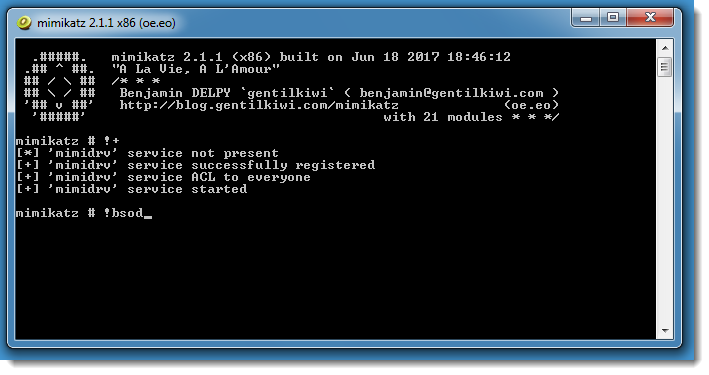
There’s a mimikatz driver command to initiate a Blue Screen of Death: !bsod

Here I’m using mimikatz as administrator on a Windows 7 machine (because I’m not a fan of the new BSOD introduced with Windows 8):

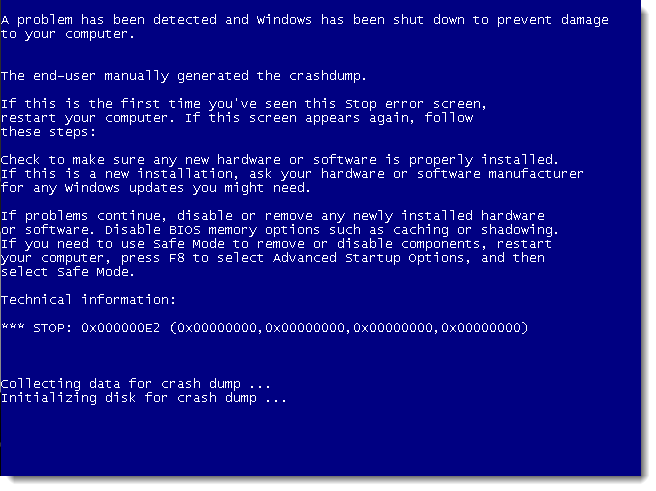
It’s a MANUALLY_INITIATED_CRASH (STOP 0x000000E2).


Quickpost info


Thursday 6 July 2017

I Will Follow (no, not talking about social media)

Filed under: maldoc,Malware — Didier Stevens @ 20:54

I can’t help feeling some kind of satisfaction when a friend uses my tools to analyze malware, and hacks his way to a solution when my tool falls short 🙂

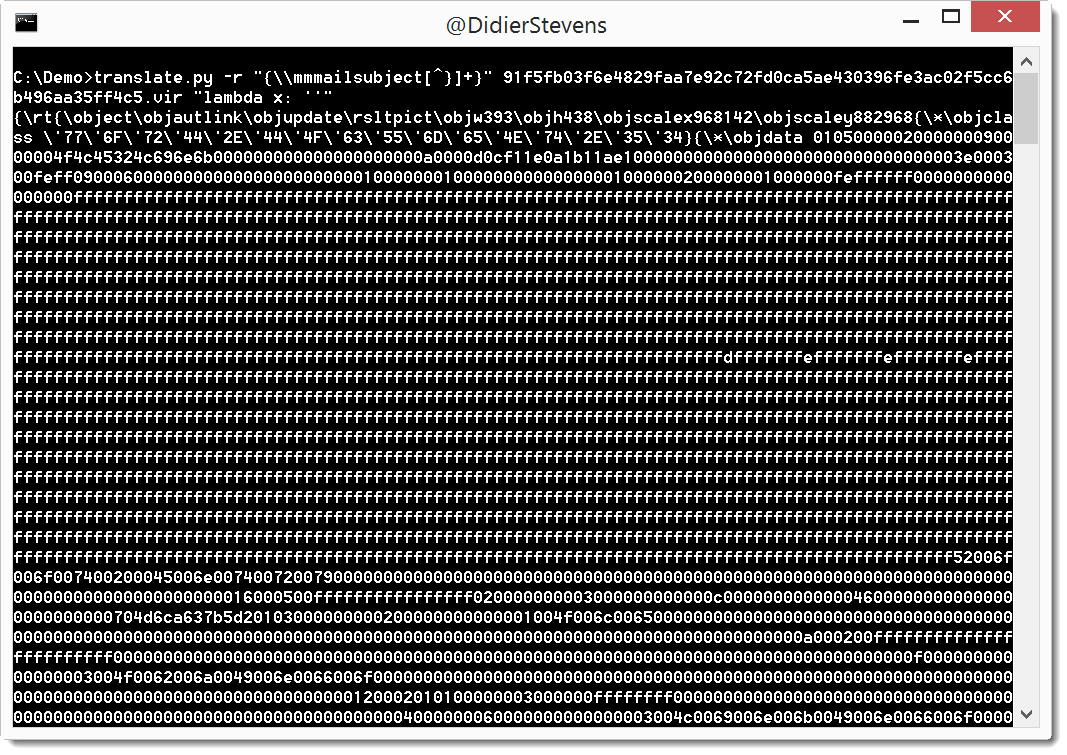
In this nice blogpost, @bluejay00 analyzes RTF malware with my rtfdump.py tool. But because of obfuscation, rtfdump.py is not able to extract the object. @bluejay00 understands this, deobfuscates the RTF sample with an editor, and is then able to get my tool to work correctly.

I’ll just show how I would have used my translate.py tool to remove the obfuscation:


Wednesday 5 July 2017

Update: re-search.py Version 0.0.8

Filed under: My Software,Update — Didier Stevens @ 17:26

This new version of re-search.py introduces options –script and –execute to provide your custom Python functions.

Regular expressions can contain comments, like programming languages. This is a comment for regular expressions: (?#comment).
If you use re-search with regular expression comments, nothing special happens:
re-search.py “(?#comment)[a-z]+\.com” list.txt

However, if your regular expression comment prefixes the regular expression, and the comment starts with keyword extra=, then you can use gibberish detection, whitelist/blacklist filtering and Python function matching.

Python function matching is defined via directive P (Python). If you want to validate a string with a Python function, you use the following regular expression comment: (?#extra=P:Validate). Validate is a Python function that takes a string as argument and returns a boolean: True for a match and False if there is no match. You can provide your custom Python function(s) in a file via option –script or as a commandline argument via option –execute.

Example: Bitcoin address matching. Regular expression [13][a-km-zA-HJ-NP-Z1-9]{25,34} will match Bitcoin addresses, but also other strings that look like a Bitcoin address but are not a valid Bitcoin address. A valid Bitcoin address has a particular syntax, and a valid checksum. The regular expression can check the syntax, but not validate the checksum. Python function BTCValidate can check the checksum of a Bitcoin address. The following regular expression matches Bitcoin addresses with a valid syntax and uses Python function BTCValidate to validate the checksum:
(?#extra=P:BTCValidate)[13][a-km-zA-HJ-NP-Z1-9]{25,34}

re-search_V0_0_8.zip (https)
MD5: D4895B54268683BFBE0126D02B01A4A2
SHA256: 85919EB964FF9CF0EDE7DA64E9BCE6619480DAC71D0CB65B5EE667322B18DDBB

Tuesday 4 July 2017

Update: pecheck.py Version 0.7.0

Filed under: My Software,Update — Didier Stevens @ 0:00

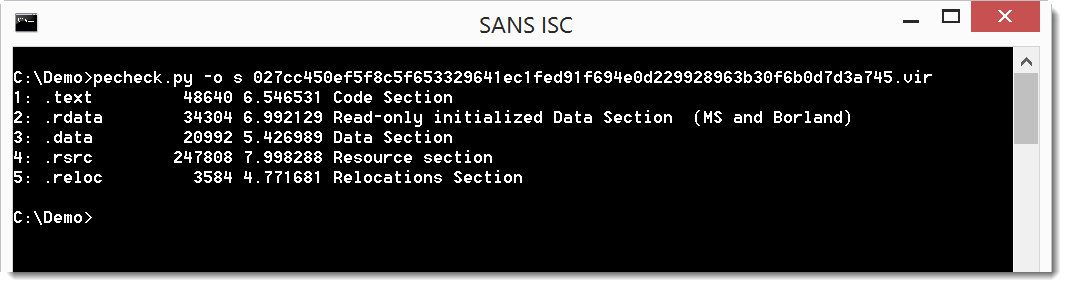
This new version of pecvheck.py adds an overview of sections. More details here.

pecheck-v0_7_0.zip (https)
MD5: 7BE550EC71BF99FC31704C2DD4ED3C8A
SHA256: 12C03369362045DF5A9AAB83002E59A4A31050EC008DF45F777C87186D611F6E

« Previous PageNext Page »

Blog at WordPress.com.