I will release free stuff on my company’s website Didier Stevens Labs. Like this new XORSearch video.
XORSearch is one of my popular tools, but I hadn’t made a video for it yet:
I will release free stuff on my company’s website Didier Stevens Labs. Like this new XORSearch video.
XORSearch is one of my popular tools, but I hadn’t made a video for it yet:
You probably know by now that Adobe will revoke a compromised code signing certificate in a couple of days. As we seem to have more code signing related security incidents recently, I started to develop a couple of new tools.
AnalyzePESig is a tool to check signatures in PE files, just like Sysinternals’ sigcheck. But with a couple of differences.
First, when a signature is not valid, AnalyzePESig will tell you why and still display information about the invalid signature and related certificates. Second, AnalyzePESig displays more information and third, it is open source.
Here is how you use AnalyzePESig to look for executables signed with that Adobe certificate that will soon be revoked:
analyzepesig -e -v -s -o windows.csv c:\windows
This will produce a CSV list of all executables found in the c:\windows directory.
Filter this list for lines including string fdf01dd3f37c66ac4c779d92623c77814a07fe4c (this is the fingerprint of the compromised certificate):

As you can see, I’ve Flash components signed with this compromised certificate. Now, this does not mean that these executables are compromised. To get a better idea, I can use my virustotal-search tool to search VirusTotal.
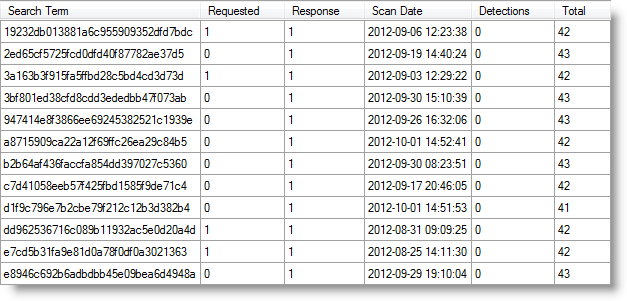
And here is another example, JP2KLib.dll, a DLL of Adobe Reader X:

AnalyzePESig_V0_0_0_1.zip (https)
MD5: 4BE29E4A5DE470C6040241FD069010C4
SHA256: FB83C6491690402273D42A3335777E77EA29328F5FE8503FF6F5EF62833D1FBC
This is a small fix for TaskManager suggested by goglev: he had 2 network drives pointing to the same share, and this triggered a bug.
Since it was brought to my attention that some AV products detect the version with shellcode, I’m forking the project:
TaskManager.xls has no shellcode injection features, while TaskManagerSC.xls does.
TaskManager_V0_1_4.zip (https)
MD5: FBB30486CF0E7A1BEB7342EF4672DE52
SHA256: 30779E09B5B0D1D1AFE9C33B12EDD0982E775A9FA0B0D2A1189835004750FB5F
TaskManagerSC_V0_1_4.zip (https)
MD5: 61C6657B2E36F3240A67960BCA413E56
SHA256: FAAB1044318A1EB6FEA09109ABDD982CDFFAEE54DC1C81D3416CC2A69DEEEC70
The most important feature in this new version is the pivot table. You can select 2 columns and generate a pivot table for the data in these columns. Here is an example with data from a new tool I’m working on:

FYI: this shows which root certificates are present in the AuthentiCode signatures using MD5 or SHA1.
Here’s a list of changes:
InteractiveSieve_V_0_7_6_0.zip (https)
MD5: 37C18D2E41CB311442E033F253818057
SHA256: 5758289A939388FDB73617DAD686EBD2B79D1E48444A772946E7606DAF49DB05
This new version of USBVirusScan displays a banner when a USB stick is inserted. You specify the text of the banner in text file banner.txt.
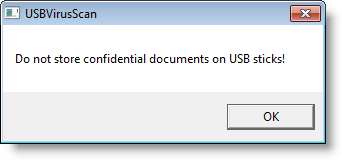
Option -b enables this banner and displays it the first time a removable drive is mounted. Option -B displays the banner each time a removable drive is mounted.
You can find this new version here.
I fixed InstalledPrograms as earthsound suggested: now I include 32-bit installations on 64-bit systems (provided you use 64-bit Excel).
InstalledPrograms_V0_0_2.zip (https)
MD5: 383D9EC2B520E930A8484F1BD0B99534
SHA256: B174A5A9A366799B5C7CB99D6FD83643E5AE8155FBC52ADCEDA836FFF9281766
Help Net Security recorded a video with me speaking about EMET and HeapLocker at Hack In The Box Amsterdam 2012.
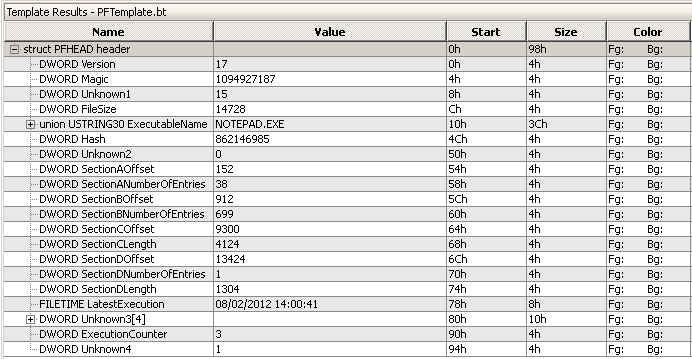
I had some problems with a Windows XP prefetch file, so I wrote a 010 Editor template using the Forensics Wiki’s information on prefetch files.
PFTemplate.zip (https)
MD5: 11F6BB8EC0D29CBCC7C2F269E9900AF0
SHA256: 4429380778C94E47427C1753BAF91E0D8AF78985AA9F3868CF3FC07456F7BAFA
Congratulations to the winners of the BlueHat Prize contest.
My entry was CounterHeapSpray:
CounterHeapSpray monitors the private memory usage of an application to guard against heap sprays. When the private memory usage of the application exceeds a predefined threshold, CounterHeapSpray assumes that a heap spray is ongoing and will pre-allocate virtual memory pages and populate these pages with its own shellcode. When the heap spray terminates and the exploit executes, code execution will transfer to CounterHeapSpray’s own shellcode. This shellcode will suspend all threads and display a warning message for the user. When the user clicks OK, CounterHeapSpray’s shellcode terminates the application.
By planting its own shellcode before the heap spray can fill the heap with malicious shellcode, CounterHeapSpray not only prevents execution of this malicious shellcode but is able to suspend the process and to inform the user of the attack.
CounterHeapSpray.zip (https)
MD5: 1947380F935AE0B1A8828DE79621F82F
SHA256: CA0BF635655EE05ABED117C858BC86ECDF3EBB4C39544D7D0C396D7C457F1BBC
I finally took the time to merge UserAssist version 2.4.3 and UserAssist version 2.5.0 (Windows 7) into UserAssist version 2.6.0.
Thus version 2.6.0 supports all versions of Windows starting with Windows 2000 up to Windows 8. Support for Windows 8 is experimental.

UserAssist_V2_6_0.zip (https)
MD5: 04107FE15FC676B7A701760C9C6D2F81
SHA256: F6F73F4E00905A7727ED4136DE875DD1FBCF4B90FFEE4B93D4A46E58C0314D45

 Didier Stevens