This version has some Python3/Linux/MacOS fixes.
re-search_V0_0_18.zip (https)MD5: 1BCA3B59B719FAFD6016D2F9F32F1A05
SHA256: 9E4807D3CE0EC320028AC760D3915F4FC0CBF6EC6E20FC9B2C91C54E74E6F548
This version has some Python3/Linux/MacOS fixes.
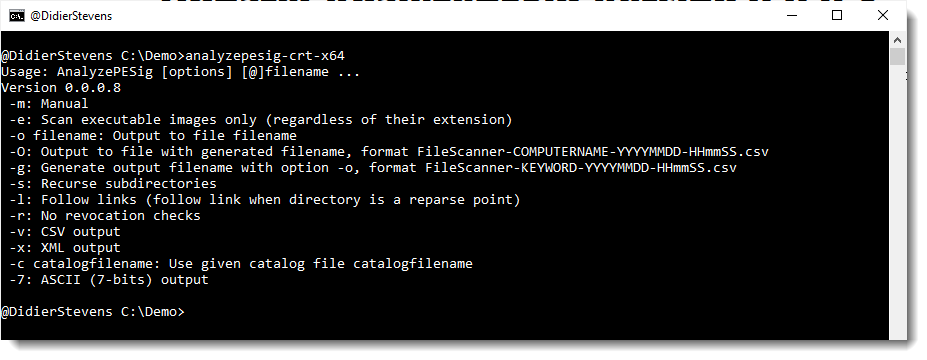
re-search_V0_0_18.zip (https)This new version of AnalyzePESig, my tool to analyze the digital signature of PE files, brings some major updates:
And several bug fixes.
This is a bug fix version.
pdf-parser_V0_7_5.zip (https)This is a bug fix version
pdfid_v0_2_8.zip (https)This new version brings a bug fix and an update to plugin_biff’s XOR deobfuscation.
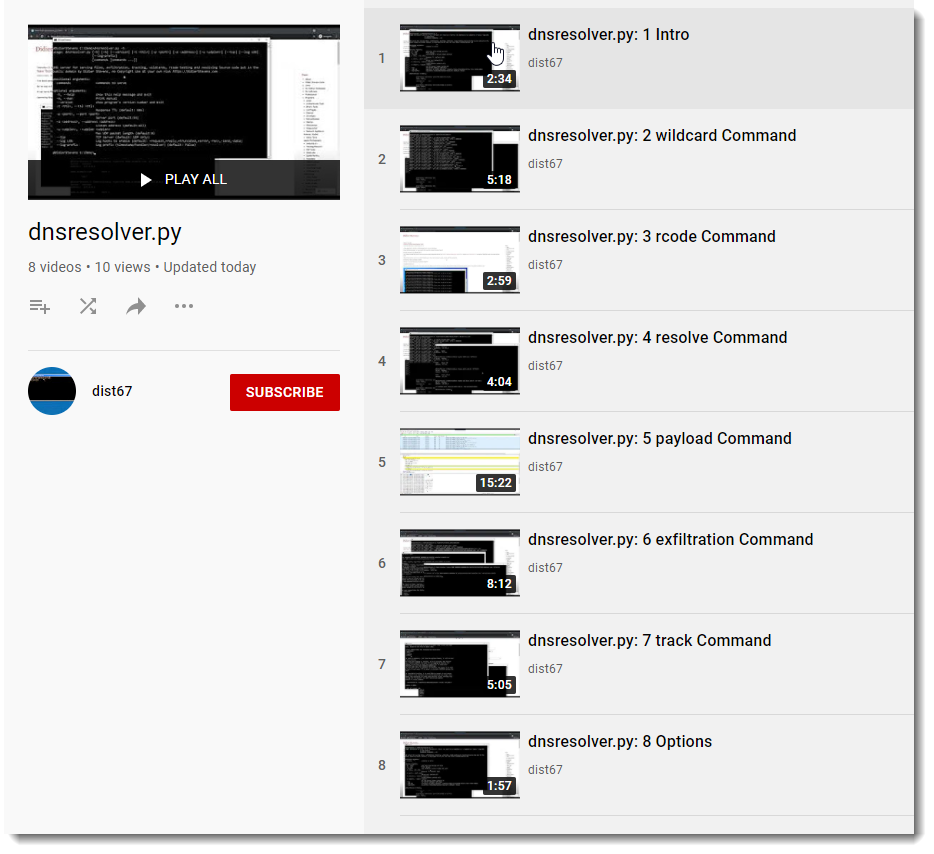
oledump_V0_0_62.zip (https)I did record 8 videos explaining the different commands of my dnsresolver.py tool.
This is a tool that can serve files, facilitate exfiltration, do tracking, answer wildcard requests, do rcode testing and also simple resolving.
I have a YouTube playlist with all 8 videos: dnsresolver playlist.
This new version of base64dump.py brings bug fixes and support for BASE85 RFC 1924 encoding.
If you want to know how I go about adding a new decoding to base64dump.py, watch this video:
Here is version 0.0.0.15, with bug fixes but without base85:
base64dump_V0_0_15.zip (https)And here is version 0.0.0.16 with base85:
base64dump_V0_0_16.zip (https)I’ve done several experiments with DNS, which has lead me over the last couple of years to develop a DNS resolver tool.
By no way is it a full fledged DNS server: it implements particular features that I’ve needed for different experiments I conducted.
It can serve files, facilitate exfiltration, do tracking, answer wildcard requests, do rcode testing and also simple resolving.
Upcoming blog posts will go into more details for some of these features.

This new version of FileScanner brings bug fixes and new features, like UNICODE filename support and an embedded man page.

I have some ad hoc tools, that help me with special text editing tasks. Like doing search and replace in a text file, with a list of search and replace terms. Or looking for assignment statements in the source code of a program, and replacing each variable with its value.
I decided to bundle these ad hoc scripts, into a single generic script, a new tool: texteditor.py
Here is an example, take text file example.txt with the following content:
There is an apple on the sun.
It is nice and warm.
And CSV file sar.csv with the following content:
apple,pear
sun,moon
The following sarcsv command edits file example.txt with sar.csv:
./texteditor.py input=example.txt edit=sarcsv,file=sar.csv output=-
The output of this command is:
There is an pear on the moon.
It is nice and warm.


