Didier Stevens

Tuesday 11 June 2019

Quickpost: C Random Functions in Other Languages

Filed under: Quickpost — Didier Stevens @ 0:00

Some time ago, I had to implement a particular C-runtime random number generator in Python. That’s not difficult to do, you just need a variable that maintains the state (seed) of the random number generator, and then you use a simple algebraic expression: a linear congruential generator.

What’s more difficult to figure out, is knowing which multiplier (a) and increment (c) you need to reproduce the particular C-runtime random number generator.

Fortunately, I discovered that Wikipedia has a table with a and c values for many C compilers and other languages: parameters in common use.


Quickpost info


Monday 10 June 2019

Update: sets.py Version 0.0.3

Filed under: My Software,Update — Didier Stevens @ 9:21

sets.py is a program to perform set operations. In this new version, I added operations unique, product, substitute and sort.

And I added options -s and -i.

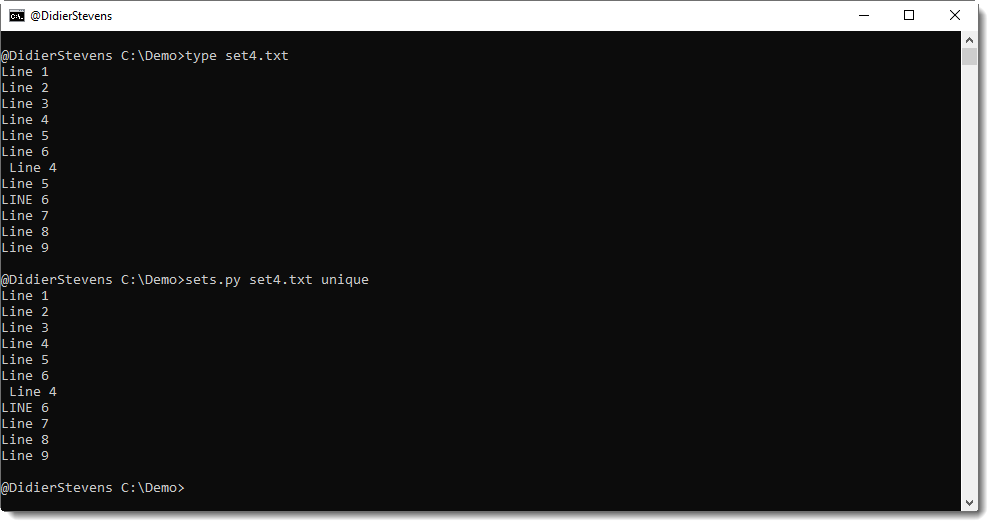
Operation unique will remove all double entries (which shouldn’t occur anyway in a mathematical set):

“Line 5” appears twice in set4.txt, thus one occurrence is remove by operation unique. “Line 4” and “Line 6” not, because their case is different, or because they have leading whitespace.

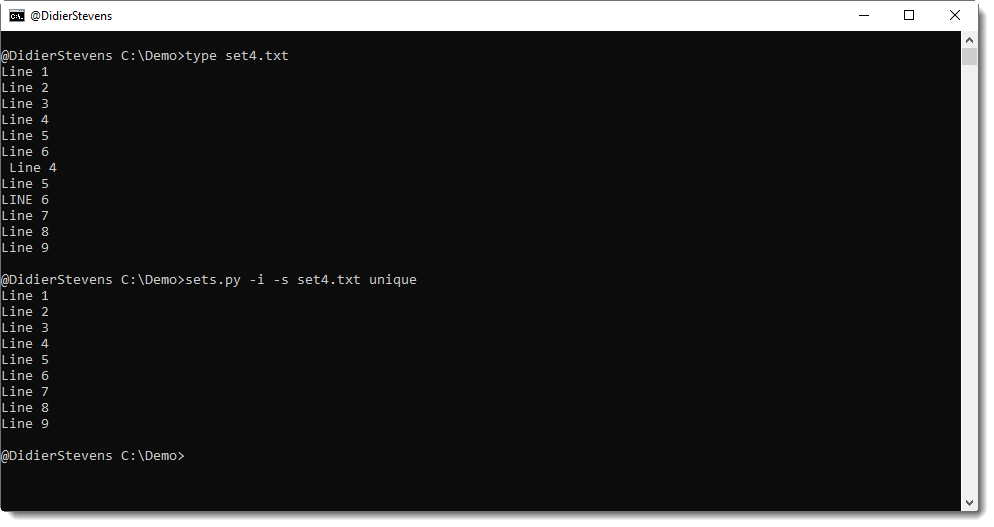
To ignore case, use option -i, and to ignore leading and trailing whitespace, use option -s:

sets_V0_0_3.zip (https)
MD5: F8B1EB9140EBA621CBF6F393717BF2EA
SHA256: 94200F8313A66D7CAB6C200A24DD6A5B1D9644004C2ECCF01F22004A801EFE03

Saturday 1 June 2019

Overview of Content Published in May

Filed under: Announcement — Didier Stevens @ 0:00

Here is an overview of content I published in May:

Blog posts:

YouTube videos:

Videoblog posts:

SANS ISC Diary entries:

NVISO blog posts:

Friday 31 May 2019

Update: hex-to-bin.py Version 0.0.2

Filed under: My Software,Update — Didier Stevens @ 10:47

This new version comes with option -a to parse ASCII/hexdumps as produced by my tools.

Option -s can be used to select another hexadecimal/ASCII dump than the first one (for example, -s 2 to select the second dump).

Option -l (list) can be used to produce an overview of all hexadecimal/ASCII dumps found in the input, together with an index number to be used with option -s.

hex-to-bin_V0_0_2.zip (https)
MD5: 4F415E4117EC497C52E244A7087E36B9
SHA256: D283C312CC169419BC16D9199F5EC850D5D7565B9FDB272CA5236F97EDAD22C3

Tuesday 28 May 2019

Update: zipdump Version 0.0.15

Filed under: My Software,Update — Didier Stevens @ 0:00

This update is just a small change to the help description, to clarify password dictionary attacking with the build-in password list.

zipdump_v0_0_15.zip (https)
MD5: 148D49FC54477C12EBB620FDCEF61AA2
SHA256: DE6FE35FA281FAD9BBF8C56883212519E60FDF0BCAFB3AFBBF964E5C808CCA2D

Monday 27 May 2019

DSSuite: A Docker Container With My Tools

Filed under: Announcement,My Software — Didier Stevens @ 0:00

I want to thank Xavier Mertens for creating a Docker container with my tools (GitHub): DSSuite.

Details can be found in ISC diary entry “DSSuite – A Docker Container with Didier’s Tools“.

Monday 20 May 2019

WebDAV, NTLM & Responder

Filed under: Encryption,Networking — Didier Stevens @ 0:00

I was trying to create a capture file with NTLM authenticated WebDAV traffic, using Responder: I couldn’t get it to work. There was WebDAV traffic, but no NTLMSSP headers.

Long story short: there’s a bug in Responder version 2.3.3.9. It manifests itself when the WebDAV client sends a request with just headers, and “Content-Length: 0”, like this:

The code in Responder “sees” just “Content-Length” and waits for more packets:

I made a quick & dirty fix: break out of the loop when we see “Content-Length: 0” (servers/HTTP.py):

And now I have NTLMSSP headers:

I just start my modified version of Responder:

Generate WebDAV traffic from a Windows 7 client:

And Responder participates in the challenge:
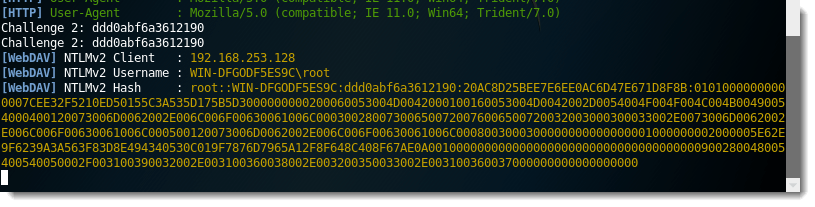
This can of course be cracked (if the password is not too complex), with John The Ripper for example:
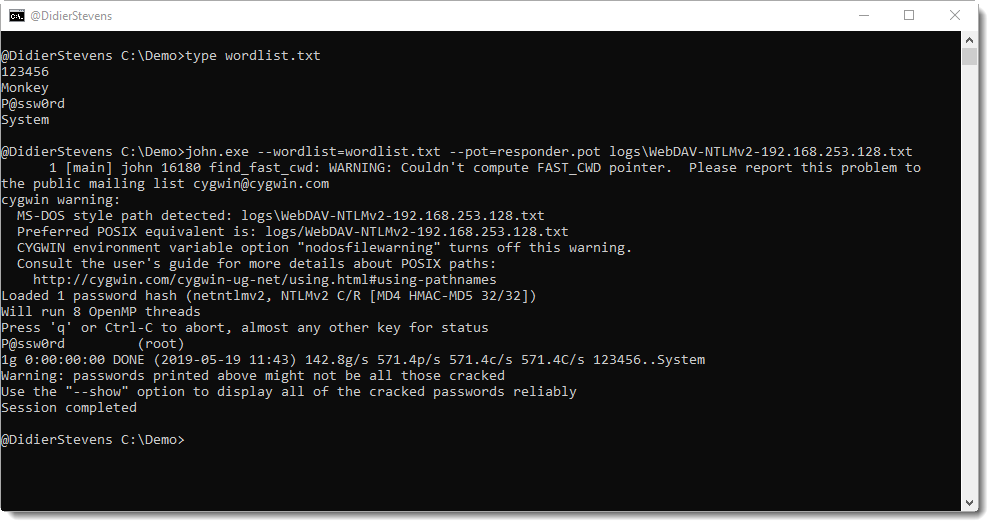
I also have a blog post with more details about WebDAV traffic from Windows clients.

Once I got Responder to work, I searched on Laurent’s Responder repository, and found a pull-request to fix issues with “Content-Length: 0” requests (this PR has not been merged yet). Hence I’m not going to do my own PR.

You can find the capture file here:

webdav-ntlm-responder.zip (https)
MD5: A427DDBDAF090E93BB75B7A8DE696826
SHA256: 2F92CDD7382DD3622AC1F8769CF9D065C60C235DEF764E6709C32E2C4A7554A8
Sunday 19 May 2019

Quickpost: Retrieving an SSL Certificate with nmap

Filed under: Encryption,Networking,Quickpost — Didier Stevens @ 8:28

One of my first quickposts, more than 10 years ago, was an howto: using openssl to retrieve the certificate of a web site.

Since then, nmap has a scripting engine, and there is a script to check a certificate with nmap: ssl-cert.nse.

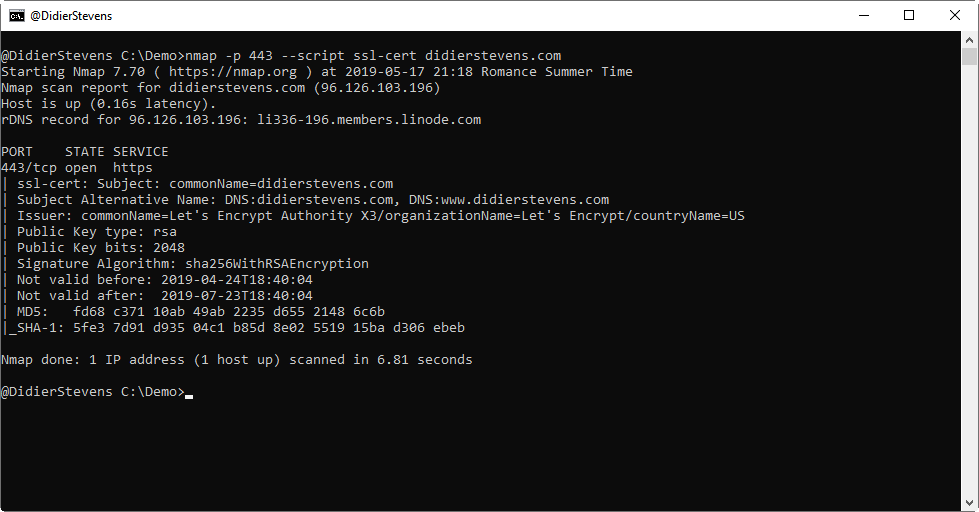
You just have to scan the site and port for which you want to check the certificate, like this: nmap -p 443 –script ssl-cert didierstevens.com

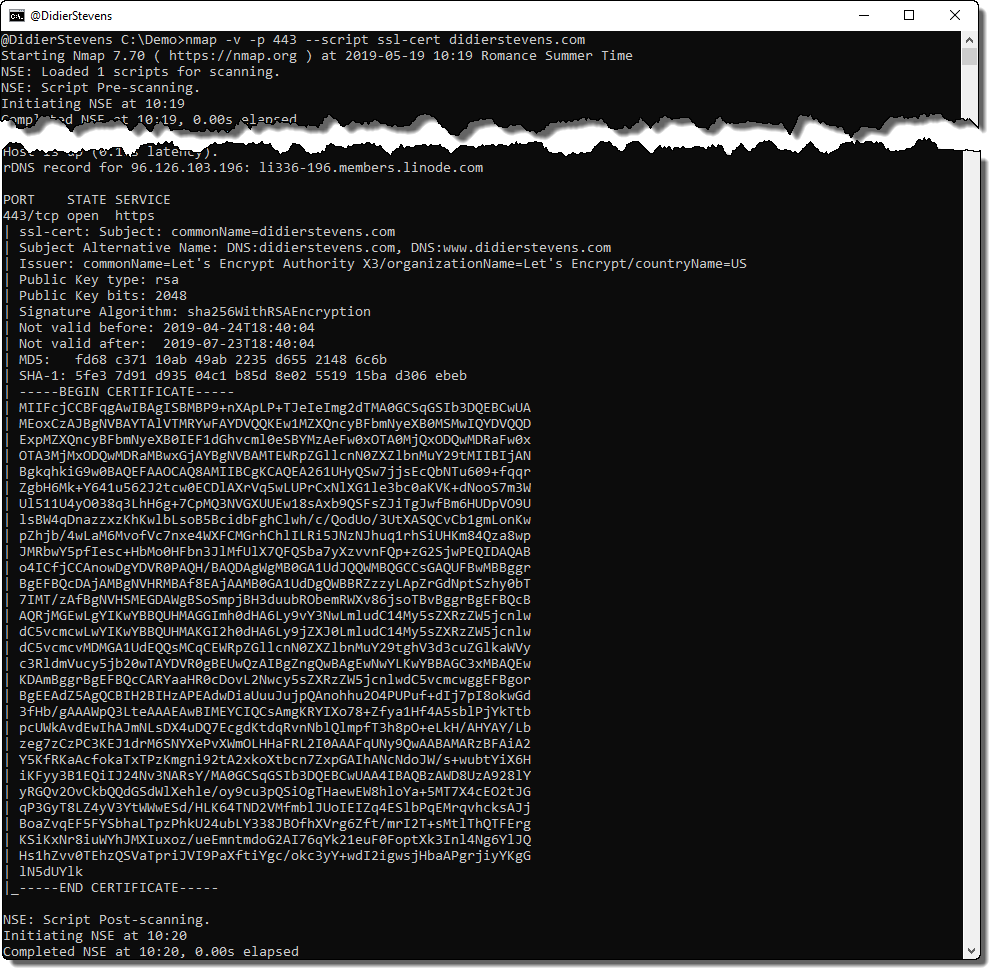
If you want the certificate too, increase verbosity with option -v:

Checking a certificate will not work if you scan a port that is not known to provide SSL/TLS:

In that case, you have to use service discovery (-sV):


Quickpost info


Overview of Content Published in April

Filed under: Announcement — Didier Stevens @ 7:55

Here is an overview of content I published in April:

Blog posts:

YouTube videos:

Videoblog posts:

SANS ISC Diary entries:

Sunday 28 April 2019

Update: jpegdump.py Version 0.0.7

Filed under: My Software,Update — Didier Stevens @ 0:00

This new version of jpegdump.py (a tool to analyze JPEG pictures) adds 2 new options: -t and -A.

Option -t: consider everything after the first EOI as trailing.

Option -A: perform ascii dump with RLE

jpegdump_V0_0_7.zip (https)
MD5: DF600AAADD1E6335CB1DC5FEF895B2AE
SHA256: 123CDBACA0533BE975751F935EA9C6CEF75B7F8E67CC0FBAD36F8C66DD9354D8

« Previous PageNext Page »

Blog at WordPress.com.