This new version brings extra statistics with option -f (fullread): counter for unique bytes, control bytes, printable bytes, high bytes. And lengths of the longest ASCII string, ASCII hexadecimal string and ASCII base64 string.
Remark that no check is made for hex string length being a multiple of 2 and base64 string length being a multiple of 4.
Rule DMP for minidumps was added.
And option -e now accepts multiple extensions (comma separated).
This new tool, teeplus.py, is an extension of the tee command.
The tools takes (binary) data from stdin, and sends it to stdout, while also writing the data to a file on disk.
While the tee command requires a filename as argument, teeplus.py takes no arguments (only options).
By default, teeplus.py will write the data to a file on disk, with filename equal to the sha256 of the data and extension .vir.
And it will also log this activity in a log file (teeplus.log by default).
Here is an example.
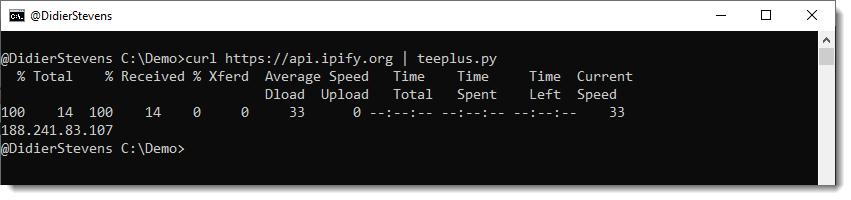
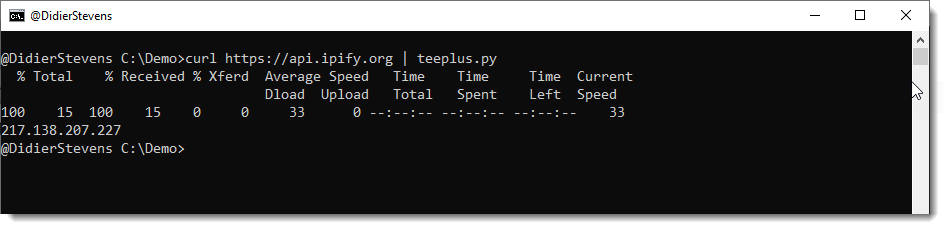
I run curl with a request to ipify to get my current public IPv4 address:
Then I pipe this output to teeplus.py:
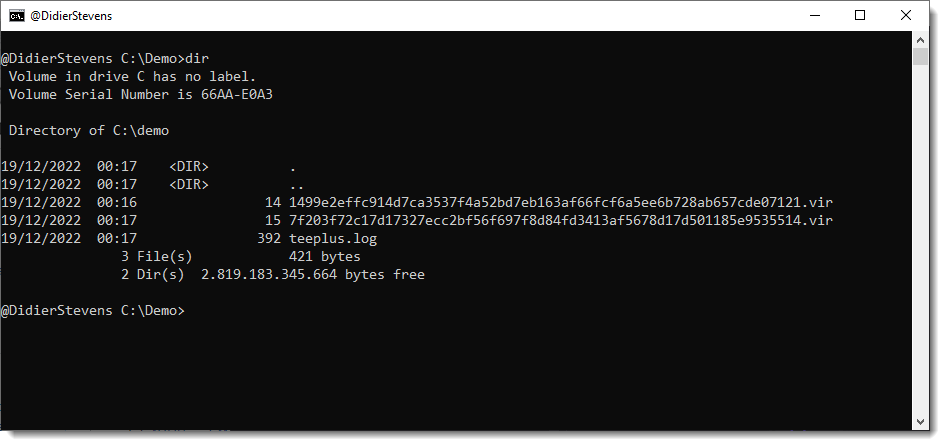
This results in the creation of two files inside the current directory:
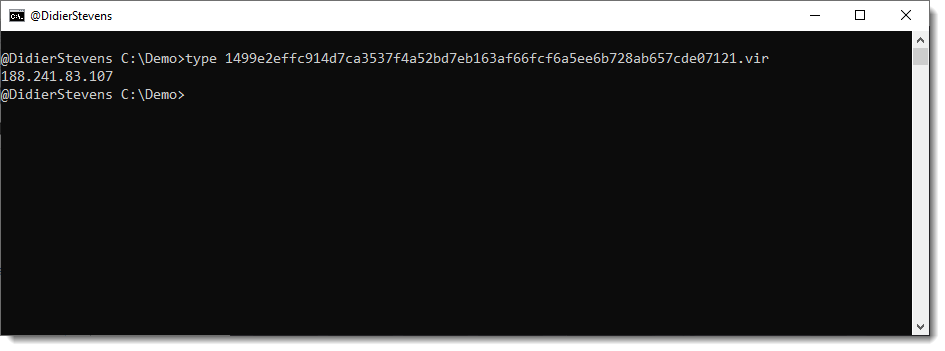
The first file it the output of the curl command:
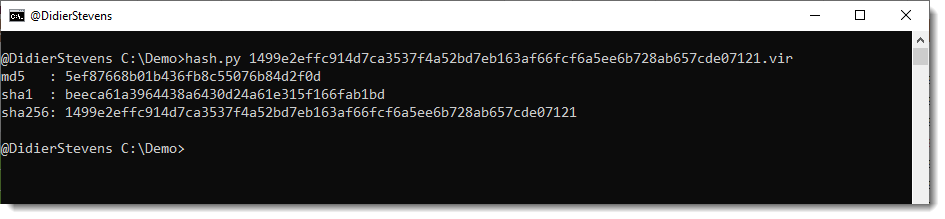
The filename is the SHA256 hash of the data with extension .vir:
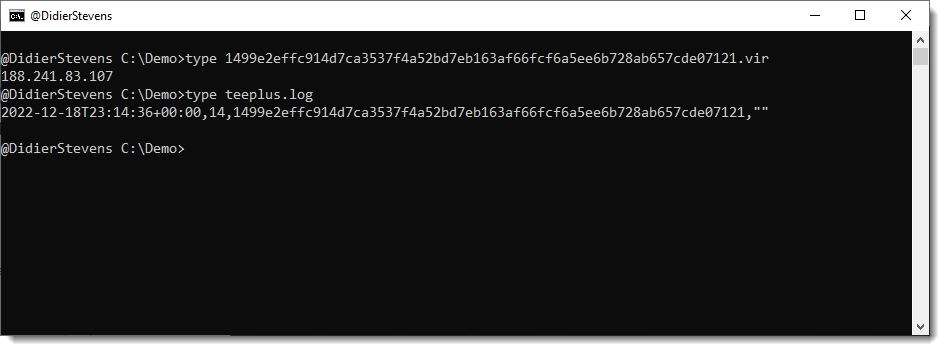
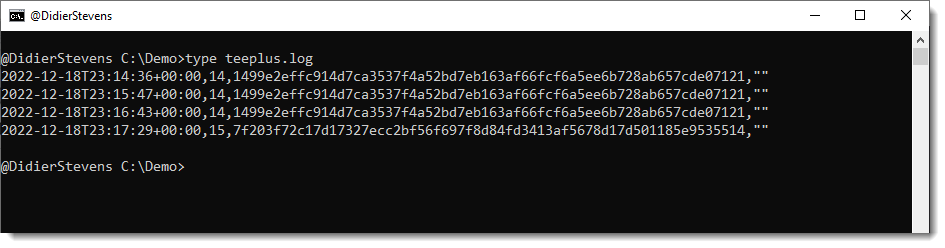
The second file, teeplus.log, is a log file:
Each line in teeplus.log has 4 fields (comma separated):
The ISO timestamp when the activity was logged
The length in bytes of the data
The SHA256 hash of the data
An error message (empty string when no error occured)
A line is created for each invocation of the teeplus.py command:
When the IPv4 address changes:
And the command is executed again, a new .vir file is created (since the received data changed):
And this is reflected in the log file:
This allows you to create a log of your public IPv4 address, for example (by scheduling this command as a recurrent task).
I use it for monitoring websites, and saving a copy of the HTML page I downloaded. I will explain how in an upcoming blog post.
teeplus.py has a couple of options: you can change the extension of the saved file, and the filename of the log file. And you can also us option -n to prevent the data to be piped to stdout (or you could redirect to /dev/null).
This is something I would do when the teeplus.py command is not followed by another command.
Option -W can be used to write all files to disk. The only accepted value for -W is vir (for the moment). When this option is provided, all files are written to the local disk (ignoring contained paths) with their original name, and appended extension .vir.
To print out properties line per line, use separator *.
And more parsing for PK records has been added (with option -f). This is a work in progress, more info will provided in an upcoming blog post.






 Didier Stevens