Didier Stevens

Sunday 27 August 2023

Update: sortcanon.py Version 0.0.3

Filed under: My Software,Update — Didier Stevens @ 17:44

Some new options for my tool sortcanon.py to handle more inputs.

A bit of context: when one sorts a list of IPv4 addresses as text, one gets a result as follows. Take this list:
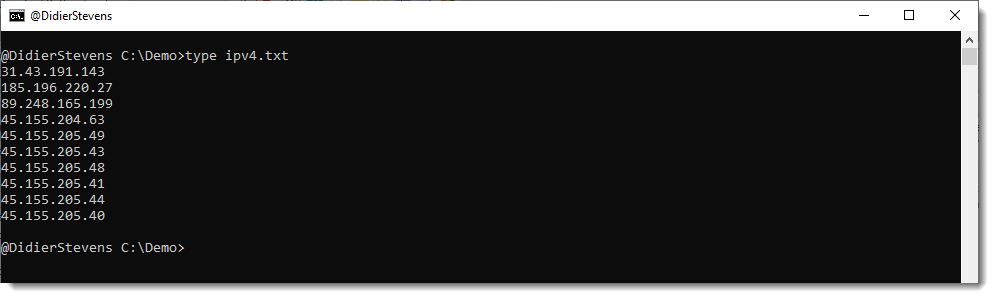
Just sorting this gives this result:

The IPv4 address starting with 185 comes first, because by default, sorting is string based and digit 1 comes before digit 3.

With sortcanon, one can provide a Python function that will be used to interpret the input and achieve the desired sorting. There are a couple of builtin functions, like ipv4. This is the result:
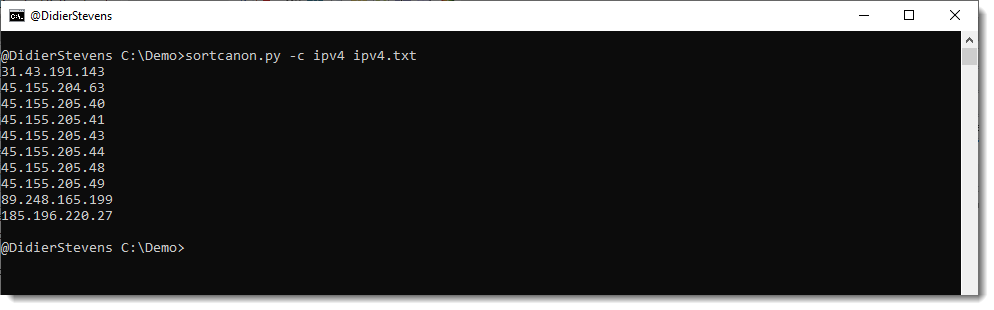
This time, the IPv4 address starting with 185 comes last, because it has the highest most significant byte.

Recently, I had to sort some files where with extra data, like IPv4 addresses with port numbers. Something like this list:

But this did not work:
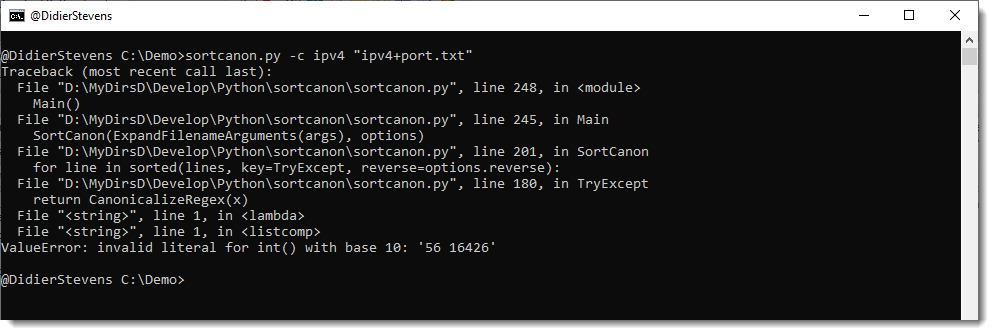
Because the function that parses IPv4 addresses, does not expect a port number.

I could create a custom function to handle this, but I pursued another solution. I added an option to select the part of the line, that will be used for sorting, with a regular expression. This is done with option -s (select). Like this:
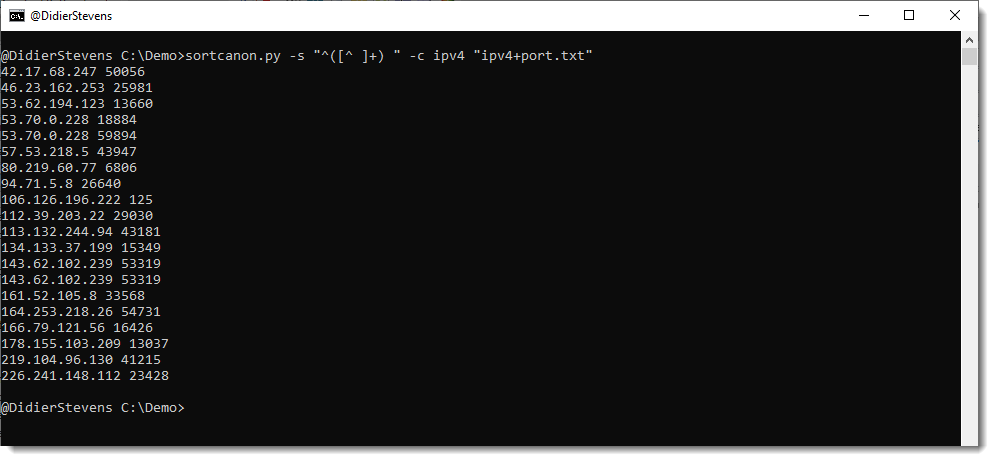
Regular expression “^([^ ]+) ” selects all characters from the beginning of the line (^) until the first space character (excluded). This selection is stored in a capture group (), and the ipv4 sorting function takes this capture group as input, in stead of the complete line.

The list I selected as example, has some duplicate IPv4 addresses:
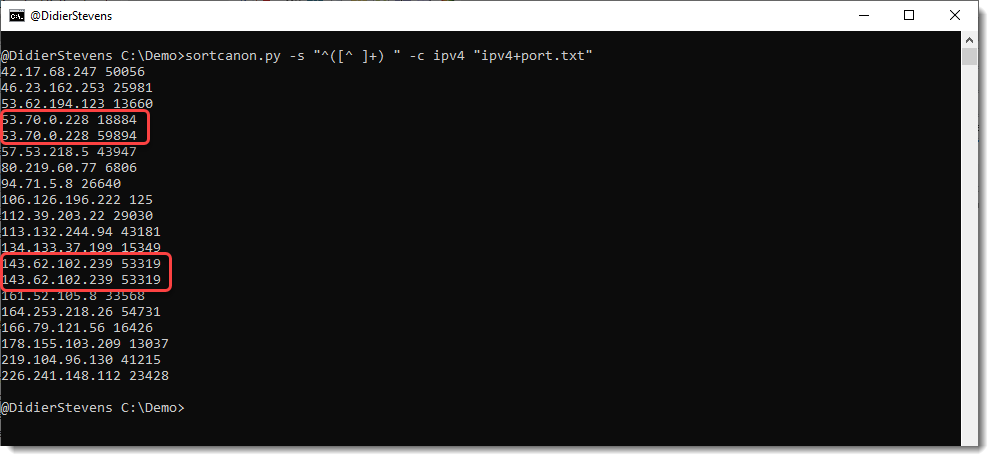
If I use option -u (unique), duplicate lines are removed:

But of course the lines with identical IPv4 address 53… remain, because the lines themselves are different (different port number).

This is the desired result, most of the time. But I had an exceptional case, where I had to drop duplicate IPv4 addresses, but still keep one port number. This can be done with option –selectoptions u:

sortcanon_V0_0_3.zip (http)
MD5: CF742211DCF5AD893B882658980E6998
SHA256: 44DECFCDCA4966F8A8A2B1172EFA6B706294935C20D6A12C5A68F5D395396A77

Sunday 16 July 2023

Update: zipdump.py Version 0.0.27

Filed under: My Software,Update — Didier Stevens @ 8:04

This is a bug fix release.

zipdump_v0_0_27.zip (http)
MD5: 91A26333FB6E2FF23A37462B5031A62F
SHA256: 99E628622C5D3F3AD957C7A41264850A4FA267E46DE8F8E1AF61C684774C0850

Saturday 17 June 2023

Update: zipdump.py Version 0.0.26

Filed under: My Software,Update — Didier Stevens @ 11:45

In this new version, new features/updates are:

  • Update to statistics to include longest strings (also hexadecimal and base64)
  • Write option: ziphashdir and alphanumvir
  • Brute-force password cracking
zipdump_v0_0_26.zip (http)
MD5: 5F6C82CD17D587D201D59A4B535F3702
SHA256: 90D0F0C1FA238DA9FBC6B7100B8EC01B0E155A0BBF22613B2BA22D5190ABF4DF

Tuesday 2 May 2023

Update: oledump.py Version 0.0.75

Filed under: My Software,Update — Didier Stevens @ 0:00

This update brings an new plugin: plugin_vba_dir.py (there are no changes to oledump).

This plugin parses the records found in the vba/dir stream to display project, references and modules information

oledump_V0_0_75.zip (http)
MD5: FB0F82B3B29883707A399B99C894EF08
SHA256: D357E48D827822D15C9C22C0B5204924FBA9FC59104818C9824AD149FE6F6249

Sunday 30 April 2023

Update: zipdump.py Version 0.0.25

Filed under: My Software,Update — Didier Stevens @ 9:12

Some changes to the translate option: now it supports this format (like some of my other tools):

i=codec[:error],o=codec[:error]


i= is input and o= is output. If you don’t specify an error handling mode, strict will be used.

An example of the format is: i=utf16,o=latin:ignore
This will read binary data in utf16 strict mode, and convert it to binary data in ANSI (latin) and ignore all utf16 characters that can not be represented in latin.

zipdump_v0_0_25.zip (http)
MD5: 141BCA65BF89E0561B42901598406113
SHA256: 54E23B4E7A3EB1B31394FCCC32F6509CFB448E0D917615C4C05E431784E70978

Saturday 8 April 2023

Update: dnsresolver.py Version 0.0.3

Filed under: My Software,Update — Didier Stevens @ 7:42

I added support for label * (wildcard label).

dnsresolver_V0_0_3.zip (http)
MD5: 18958CEEB8CD62B50D6533A477008649
SHA256: E8BB634C9D5562D640D23AA426948D166977193931794E67761F1BCD2436466E

Tuesday 4 April 2023

Update: 1768.py Version 0.0.18

Filed under: My Software,Update — Didier Stevens @ 0:00

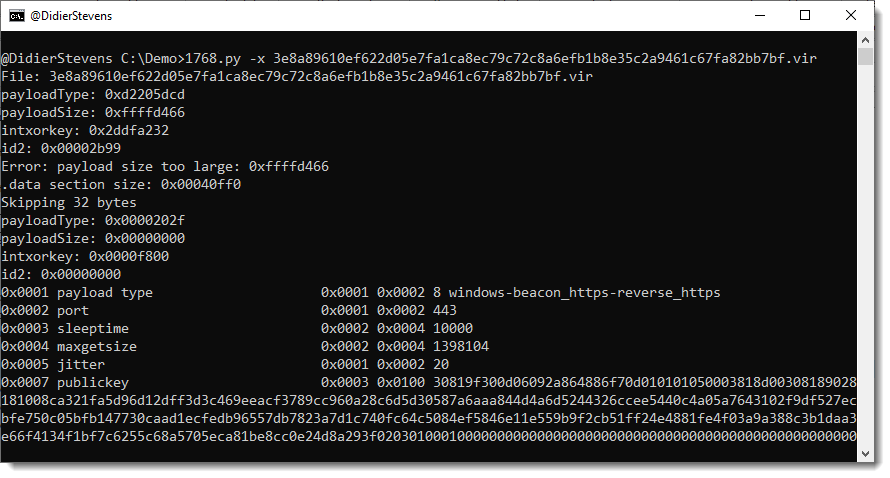
This new version of 1768.py brings an option to try out all 256 xor keys if a non-standard XOR key is used to encode the configuration.

Like this sample (key !):

1768_v0_0_18.zip (http)
MD5: 323D6D20483257D76D7F9DAD07AAF630
SHA256: 653CB75FF59C27FB9A2FD651DDE2EC81A4F577F7F9050353CB0B75DF6CA95773

Monday 3 April 2023

Update: re-search.py Version 0.0.22

Filed under: My Software,Update — Didier Stevens @ 0:00

This update to re-search.py, my tool to search text files with regular expressions, brings several new regular expressions.

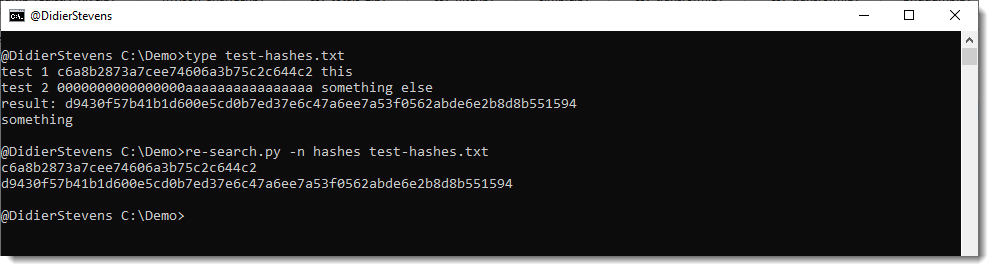
There are 4 new regular expressions for cryptographic hashes: md5, sha1, sha256, sha512. And one new name that groups these 4 regular expressions: hashes.

You can use it like this: re-search.py -n hashes sample.txt

These regular expressions not only match strings of hexadecimal characters of the appropriate length (with a boundary: \b), they also check each extracted hash with a Python function (HashValidate in re-extra.py) that is designed to eliminate strings that accidentally look like a hash (example: 32 times letter A).

HashValidate checks the following:

  • that the hash is not a mix of lowercase and uppercase letters
  • that there are more than 5 different hexadecimal digits
  • that there are more than 10 instances of a character and the next character, that are different

These simple rules are designed to detect hexadecimal strings that are too uniform, and thus probably not a hash digest.

And I also added regular expressions for strings delimited by single quotes: str-s, str-se str-su, str-seu.

re-search_V0_0_22.zip (http)
MD5: BF72647B93D30D0D9CD75EEFED85D21E
SHA256: FCF7D6EF2A5C8AEC5FC84D2CF588FCD8DAD3923E10905D3350AAD7975D926553

Sunday 2 April 2023

Update: oledump.py Version 0.0.74

Filed under: My Software,Update — Didier Stevens @ 0:00

A small update to plugin_msi_info to change the output format a bit. And you can select your preferred hash algorithm with environment variable DSS_DEFAULT_HASH_ALGORITHMS.

oledump_V0_0_74.zip (http)
MD5: FD4D73F0C1A6BE43406381C13C128D5E
SHA256: 1683635FD3250DF43E2CA31C60C2C81B507B1E233C5D91C2671D147C7FD8BD14

Wednesday 29 March 2023

Update: myjson-filter.py Version 0.0.4

Filed under: My Software,Update — Didier Stevens @ 19:48

In this update, I add option -W to write items to disk.

Option -W takes a value. Possible values are: vir, hash, hashvir and idvir.

This value determines the filename for each item written to disk.

vir: filename is item name + extension vir
hash: filename is sha256 hash
hashvir: filename is sha256 hash + extension vir
idvir: filename is item id + extension vir

For an example, take a look at my SANS ISC diary entry “Extracting Multiple Streams From OLE Files“.

myjson-filter_V0_0_4.zip (http)
MD5: 7CFB64BDE6A60DB44EBEA18DD4B966D3
SHA256: B8128DC14DC7235710AB4DF9B0B2A55C43FA2035140D5CBCDC09D9079AB6D6DA
« Previous Page — Next Page »

Blog at WordPress.com.