Didier Stevens

Thursday 19 July 2012

UserAssist Windows 2000 Thru Windows 8

Filed under: Forensics,My Software,Update — Didier Stevens @ 13:26

I finally took the time to merge UserAssist version 2.4.3 and UserAssist version 2.5.0 (Windows 7) into UserAssist version 2.6.0.

Thus version 2.6.0 supports all versions of Windows starting with Windows 2000 up to Windows 8. Support for Windows 8 is experimental.

UserAssist_V2_6_0.zip (https)
MD5: 04107FE15FC676B7A701760C9C6D2F81
SHA256: F6F73F4E00905A7727ED4136DE875DD1FBCF4B90FFEE4B93D4A46E58C0314D45

Friday 6 January 2012

Identifying IOS

Filed under: Forensics,Networking — Didier Stevens @ 10:33

Did you ever had to identify a Cisco IOS image when you couldn’t rely on the filename?

Look for strings starting with CW_ between strings CW_BEGIN and CW_END in the image file, for example like this:

You will find strings like CW_IMAGE, CW_FAMILY, CW_FEATURE, CW_VERSION, CW_MEDIA, CW_SYSDESCR and CW_MAGIC between strings CW_BEGIN and CW_END.

In this example, the IOS version is 12.4(6)T5 (CW_VERSION) and it is designed to run on 870 routers (CW_FAMILY).

The nice thing about these CW_ strings is that you will also find them in a core dump (in the data region), thus allowing you to identify the IOS version that was running on a router when the core dump was produced (provided the image runs from RAM, indicated by a letter m in the filename).

And they are also present in the uncompressed image (compressed image files are identified by a letter z in the filename).

Soon I will release a tool to validate IOS image files, you can use it to extract these CW_ strings too.

Sunday 1 January 2012

Calculating a SSH Fingerprint From a (Cisco) Public Key

Filed under: Forensics,Networking — Didier Stevens @ 17:03

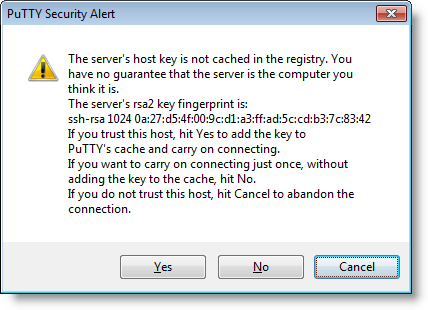
I’m sure some of you verify SSH fingerprints before you use a SSH server for the first time. You obtain the fingerprint via another channel, and you compare it with the fingerprint your SSH client presents you.

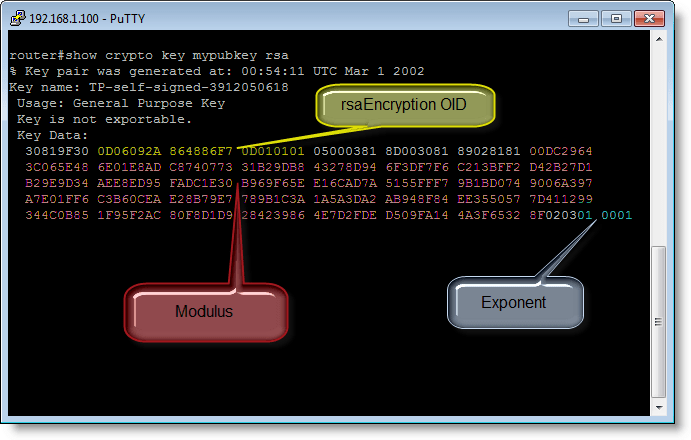
But have you done this with Cisco devices too? Recently I tried to obtain the SSH fingerprint of a Cisco router while connected via the serial console. Turns out there is no CLI command to display the fingerprint (well, at least I didn’t find one). What you can do, is dump the public key with command “show crypto key mypubkey rsa”.

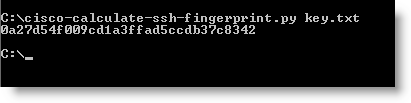
So I developed a small Python program that calculates a SSH fingerprint from the public key. You store the public key in hex format in a file and use that with this new tool.

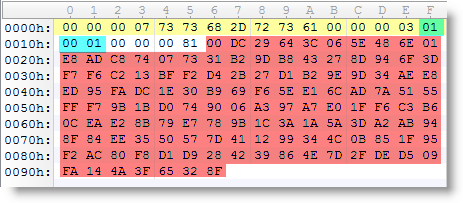
To calculate the fingerprint, I extract the modulus and exponent from the public key, store them in another format (ssh-rsa) and calculate the MD5 hash.

So now I can connect to a router via the serial console while there’s no “man in the middle”, obtain the public key and calculate the fingerprint. Next when I connect to the same router over SSH, I can validate the fingerprint my SSH client presents me. It’s too bad Cisco provides no feature to get the fingerprint directly.

cisco-calculate-ssh-fingerprint_V0_0_1.zip (https)
MD5: 5A6C3A2C466908EE7EFB06727E8D02B7
SHA256: 831CAF7BBF0F6C584436C42D9CEB252A089487B715ADBB81F9547EEB3ED6B0B8

Thursday 14 July 2011

Quickpost: Blocking and Detecting a Teensy Dropper

Filed under: Forensics,Hardware — Didier Stevens @ 9:58

A Teensy dropper presents itself as a keyboard (HID) to a PC and this is how it can be used to drop files even if you don’t allow removable drives.

You can prevent the installation of new HIDs, but this is an issue when you need to replace keyboards or mice. Irongeek has a good write-up.

Connected HIDs leave forensics traces in the registry, take a look under key HKEY_LOCAL_MACHINE\SYSTEM\CurrentControlSet\Enum\USB\

Connecting a Teensy leaves these entries:

HKEY_LOCAL_MACHINE\SYSTEM\CurrentControlSet\Enum\USB\Vid_16c0&Pid_0482\6&31417f27&0&3
HKEY_LOCAL_MACHINE\SYSTEM\CurrentControlSet\Enum\USB\Vid_16c0&Pid_0482&MI_00\7&becc88c&0&0000
HKEY_LOCAL_MACHINE\SYSTEM\CurrentControlSet\Enum\USB\Vid_16c0&Pid_0482&MI_01\7&becc88c&0&0001
HKEY_LOCAL_MACHINE\SYSTEM\CurrentControlSet\Enum\USB\Vid_16c0&Pid_0482&MI_02\7&becc88c&0&0002


Quickpost info


Wednesday 25 May 2011

Malicious PDF Analysis Workshop Screencasts

Filed under: Forensics,PDF — Didier Stevens @ 15:58

After giving my Malicious PDF Analysis workshop at Hack In The Box Amsterdam, I decided to produce a screencast for each exercise (there are 20 exercises). You can find the first screencasts here. More will be produced soon.

Materials you’ll need for the exercises:

Tuesday 17 May 2011

Another PDF Puzzle

Filed under: Forensics,PDF,Puzzle — Didier Stevens @ 8:23

As I’m going to give my workshop on analysis of malicious PDFs at HiTB Amsterdam this Thursday, I thought I would share a PDF puzzle/challenge I made for BSidesLondon.

You can download it here.

And as there is write-up for the solution to this puzzle on a blog, I’ll link to this in the comments next week. Since you can just Google the solution, there is no prize this time.

Thursday 12 May 2011

BackTrack 5 Includes PDFiD and pdf-parser

Filed under: Forensics,PDF — Didier Stevens @ 21:13

You probably noticed the release of BackTrack 5.

But did you notice the inclusion of my PDFiD and pdf-parser tools?

You can find them under /pentest/forensics/pdfid and /pentest/forensics/pdf-parser.

Tuesday 8 March 2011

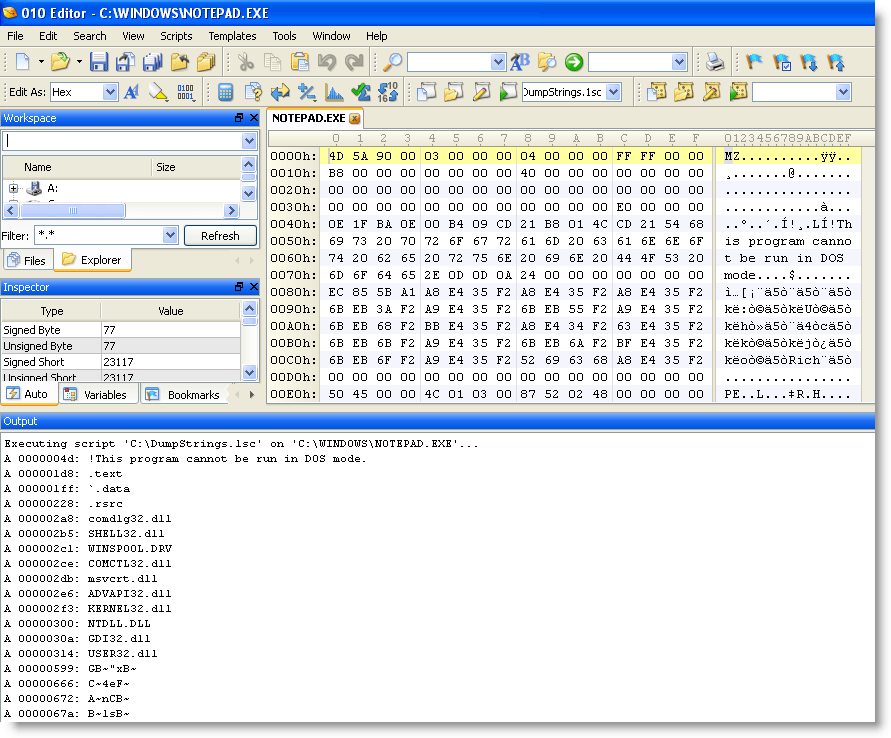
DumpStrings.1sc

Filed under: Forensics,My Software — Didier Stevens @ 0:00

I wrote another script for my 010 Editor.

Like its name implies, DumpStrings will dump all the strings (ASCII and UNICODE) found in a file, or a selection in a file, to the output tab.
Strings must be at least 5 characters long (defined with a #define statement in the script).
UNICODE support is very simple for the moment: 7-bit values in a 16-bit character (MSB or LSB).

Take into account that this is not designed for large files: it will take too long. But its easy to analyze partial files without having to save the selection for analysis with another strings tool.

Download:

DumpStrings_V0_0_1.zip (https)

MD5: 50C0C92F28020E7BCABBF46CA8775CCE

SHA256: 7EC688DBB0FD95C828067662C9ED8BBCFFEFBE5EA37B607DC8DFA1BDCB94365C

Sunday 26 September 2010

Free Malicious PDF Analysis E-book

Filed under: Forensics,Malware,PDF — Didier Stevens @ 8:41

The title says it all…

This is a document I shared with my Brucon workshop attendees.

I know, this is a PDF document, you’ve to appreciate the irony 😉

Tuesday 9 March 2010

Frisky Solitaire – Another Info Stealer

Filed under: Forensics,Malware — Didier Stevens @ 0:00

Marcus Murray gave a great talk at TechEd Berlin 2009: “Hack-Proofing Your Clients Using Windows 7 Security”. In one of his demos, he showed a trojaned Excel spreadsheet. The spreadsheet was a simple text-based game, but it had a malicious component that executed surreptitiously while the game was played.

As I’ve done several hacks with Excel macros in the past, this made me realize that social engineering is a key element to get people to run macros from a spreadsheet of unknown origin.

Several people have asked me about de details of the vulnerability I exploited in my PDF Info Stealer PoC. But that’s not important. It’s not about the exploit, it’s about the payload: the info stealer. As I’ve written in my previous post, I don’t even need an exploit to get users to execute the info stealer. If I put the info stealer inside an Excel spreadsheet and social engineer the targeted users to execute the macros, I’ve achieved my goal without exploiting a software vulnerability.

I present you Frisky Solitaire:

Frisky solitaire is more compelling than text-based Excel games, because of the graphics. I took Solitaire from ReactOS, turned it into a DLL and embedded it with my memory loading shellcode into Excel macros (the same technique as I developed for cmd.dll and regedit.dll). I imagine that a simple game like Solitaire in Excel can go viral inside a company, when you know that many corporations disable standard Windows games on their desktops and Terminal Servers.

But in a crude attempt at social engineering the male population of a targeted company, I added an element of nudity to the game. The implied message of the game’s title is that winning games increases nudity. I know, I’m talking about basic instincts here, but it still does the trick…

So I imagine that this game can become popular with a large part of the male employees of a targeted company. And that they wouldn’t question the fact you have to execute Excel macros to play a game. Sounds plausible, no?

Of course, you guessed it: Frisky Solitaire is trojaned with an info stealer… No need to exploit a software vulnerability to steal info. Given that here too, everything is done in memory, detection is unlikely.

« Previous PageNext Page »

Blog at WordPress.com.