No breaking news in this post, but I’ve found enough applications vulnerable to XML-bombs and not enough awareness around it, that I feel it justifies another web page documenting the principles behind it, together with suggestions to protect your applications from it.
The XML-bomb is a small XML document designed to expand to a gigantic size when parsed by an (unprotected) XML-parser. The huge amount of resources (memory) consumed when parsing the XML-bomb can cause a DoS or BoF.
Take this simple XML document:

And take this Document Type Declaration defining an entity e0 with value A:
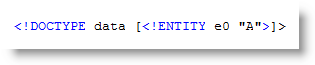
Including this DOCTYPE in our simple XML document enables us to reference entity e0 in our document, for example like this:

When this document is parsed by an XML-parser supporting DTDs, the entity reference is replaced by its value. Here is Internet Explorer rendering our XML document:

Notice that &e0; has been replaced by A.
This entity definition and referral mechanism is one essential ingredient of an XML-bomb.
The second ingredient is an expression that will grow exponentially and consume huge amounts of resources when evaluated.
We define a second entity, e1, referring twice to our first entity e0:
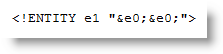
Include this definition in our XML document:
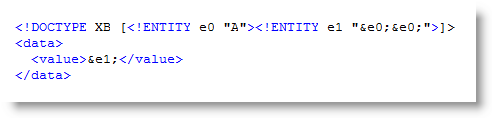
And this is how it is parsed:
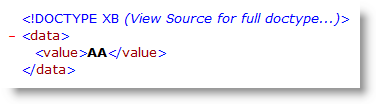
e0 evaluates to A
e1 evaluates to AA
Now define e2 referencing e1, e3 referencing e2, …, and then we get
e2 evaluates to AAAA
e3 evaluates to AAAAAAAA
…
We have achieved exponential growth! An XML-bomb with 31 entities is less than 1K in size, but entity e30 is 1GB (2^30 bytes) in size when it gets evaluated by the XML-parser!
How do you protect your application from an exploding XML-bomb?
If you don’t need support for DTDs, just disable DTDs or use a parser without DTD support.
If you need support for DTDs, try to prevent XML-bombs from entering your XML-parser by known-pattern scanning (like classic antivirus software does, for example an application firewall) or limit the impact of an expanding XML-bomb by hardening your XML-parser by restricting its consumption of resources.
You’re aware of the limitations of known-pattern scanning. This is a text-book XML-bomb, with exponential growth finding its origin in the binary tree structure. But there are many other data type structures …

 Didier Stevens
[…] Dismantling an XML-Bomb << Didier Stevens Didier walks us through how easy it is to create an XML bomb and then gives us some suggestions on how to defend against them. Very cool stuff. […]
Pingback by Interesting Information Security Bits for 09/24/2008 « Infosec Ramblings — Wednesday 24 September 2008 @ 21:03
Hello Didier, It is not the so called “One Billion Laughs Attack”?
Comment by David — Friday 30 October 2009 @ 14:41
You mean, like HAHAHAHAHA… ?
Comment by Didier Stevens — Saturday 31 October 2009 @ 17:20
[…] than a year ago, I added an XML-bomb to XMP-data inside a PDF […]
Pingback by CVE-2009-2979 Or The XML-Bombed PDF « Didier Stevens — Monday 2 November 2009 @ 7:15
Yes, I had heard something similar here http://www.ibm.com/developerworks/xml/library/x-tipcfsx.html
Comment by daganu — Monday 2 November 2009 @ 21:41
you may also want to check out vtd-xml, the latest and most advanced xml processing model
vtd-xml
Comment by anon — Wednesday 2 December 2009 @ 3:34
This helps to understand XML Bomb clearly… I like this short and sweet info — KISS ( Keep It Simple Silly ) info.
Comment by Gaurav — Monday 30 May 2011 @ 15:49
[…] https://blog.didierstevens.com/2008/09/23/dismantling-an-xml-bomb/ […]
Pingback by Demystifying RESTful Web Services (In) Securities | C&S Blog — Saturday 4 October 2014 @ 21:21