I started to create YouTube playlists for my videos.

This new version brings a bug fix and an update to plugin_biff’s XOR deobfuscation.
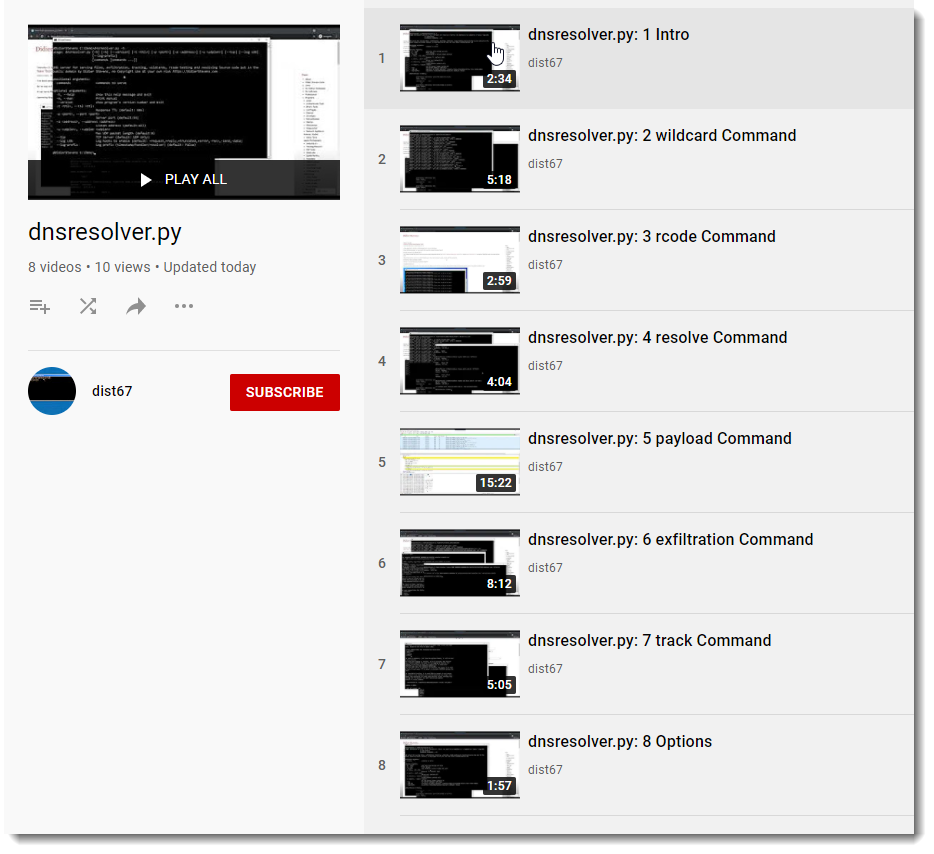
oledump_V0_0_62.zip (https)I did record 8 videos explaining the different commands of my dnsresolver.py tool.
This is a tool that can serve files, facilitate exfiltration, do tracking, answer wildcard requests, do rcode testing and also simple resolving.
I have a YouTube playlist with all 8 videos: dnsresolver playlist.

Access to files on a Windows NTFS filesystem is governed by permissions and privileges.
For permissions, it is done with a security descriptor on a file which contains a Discretionary Access Control List (DACL): these are the permissions that decide if a user has access (and which type of access) to said file. Most files don’t have their own, proper permissions: they inherit them from their parent folders.
Even administrators can be denied access to a file through DACL configuration.
But there is another mechanism that governs access to securable objects like files: privileges. A privilege is a property that a user holds. Administrators have many privileges that normal users don’t have. Like SeBackupPrivilege and SeRestorePrivilege (these are privileges necessary for backup operators).
When a user holds a privilege, it allows that user to do things that other users without that privilege are not allowed to do. For example, the SeBackupPrivilege allows a user to read any file, even if the security descriptor denies access.
But just having the SeBackupPrivilege is not enough:
1) it needs to be enabled programmatically
2) when opening a file, the intention to use the privilege must be specified
Doing this in a programming language like C is easy (for example, I programmed this into my FileScanner tool), but for Python, it’s a bit more complicated.
Part 1, enabling the privilege can be done in Python with the following code (it relies on pywin32).
import win32security
import win32api
def EnablePrivilege(privilege):
hToken = win32security.OpenProcessToken(win32api.GetCurrentProcess(), win32security.TOKEN_ADJUST_PRIVILEGES | win32security.TOKEN_QUERY)
win32security.AdjustTokenPrivileges(hToken, 0, [(win32security.LookupPrivilegeValue(None, privilege), win32security.SE_PRIVILEGE_ENABLED)])
win32api.CloseHandle(hToken)
EnablePrivilege(win32security.SE_BACKUP_NAME)
Part 2, opening the file, is typically done with WIN32 API function CreateFile and passing it the FILE_FLAG_BACKUP_SEMANTICS flag with argument dwFlagsAndAttributes.
In Python, we usually access files via function open, and not via WIN32 API function CreateFile. We can do that, but I found a simpler method.
Python’s open function has no argument where we can pass flag FILE_FLAG_BACKUP_SEMANTICS, so we cannot use open.
Python also has function os.open, it returns a file descriptor that can then be used with other file descriptor operations, like read. Like open, os.open has no argument to pass flag FILE_FLAG_BACKUP_SEMANTICS. However, someone figured out it can be done indirectly by using flag 0x2000 (os.O_DIRECTORY ?) :
fd = os.open('c:\\demo\\test.txt', 0x2000)
os.read(fd, 0x10) # read 10 bytes
Here under is a demo. File c:\demo\test.txt is only accessible (full control) by a given, normal user. And not by the administrator. This instance of Python is running under the account of an elevated administrator (so that it has the SeBackupPrivilege ready to be enabled).
When attempting to open file c:\demo\test.txt with open and os.open, permission is denied.
But after enabling SeBackupPrivilege, access via os.open is granted:


This new version of base64dump.py brings bug fixes and support for BASE85 RFC 1924 encoding.
If you want to know how I go about adding a new decoding to base64dump.py, watch this video:
Here is version 0.0.0.15, with bug fixes but without base85:
base64dump_V0_0_15.zip (https)And here is version 0.0.0.16 with base85:
base64dump_V0_0_16.zip (https)A friend asked me for more info on the QueryStatus field in sysmon‘s DNS events.
When a DNS query succeeds, e.g., when there’s a DNS reply with an answer, that status field is 0.
But what can cause it to be different from 0?
A bit of testing revealed that a query for an unknown domain gives a QueryStatus value of 9003. 9003 is a Windows System Error Code for DNS. And the rcode for NXDOMAIN is 3. So maybe the QueryStatus value is the rcode value plus 9000.
I added a feature to my dnsresolver.py script, that allows me to choose the rcode I want to receive. It works with this command-line:
dnsresolver.py “type=rcode,label=rcodetest”
And then I can just do DNS queries for a hostname like this:
4.rcodetest.example.com.
When my dnsresolver replies to such a query, it will send a reply without answer and with rcode equal to 4 (because the first label of the DNS query is 4). This allows me to quickly test different rcodes:


And this does indeed confirm that QueryStatus is equal to the rcode (greater than 0) plus 9000.
If the rcode is 0, the QueryStatus is 0, unless there is no answer in the DNS reply. Then the QueryStatus is 9501:

FYI: to test this, I configured a Windows VM with DNS server IP = 127.0.0.1, ran sysmon and dnsresolver.py inside that VM and did ping requests (I didn’t use nslookup, because that tool talks directly to the DNS server, it doesn’t use the Windows DNS client service).
I’ve done several experiments with DNS, which has lead me over the last couple of years to develop a DNS resolver tool.
By no way is it a full fledged DNS server: it implements particular features that I’ve needed for different experiments I conducted.
It can serve files, facilitate exfiltration, do tracking, answer wildcard requests, do rcode testing and also simple resolving.
Upcoming blog posts will go into more details for some of these features.

This new version of FileScanner brings bug fixes and new features, like UNICODE filename support and an embedded man page.

I have some ad hoc tools, that help me with special text editing tasks. Like doing search and replace in a text file, with a list of search and replace terms. Or looking for assignment statements in the source code of a program, and replacing each variable with its value.
I decided to bundle these ad hoc scripts, into a single generic script, a new tool: texteditor.py
Here is an example, take text file example.txt with the following content:
There is an apple on the sun.
It is nice and warm.
And CSV file sar.csv with the following content:
apple,pear
sun,moon
The following sarcsv command edits file example.txt with sar.csv:
./texteditor.py input=example.txt edit=sarcsv,file=sar.csv output=-
The output of this command is:
There is an pear on the moon.
It is nice and warm.