Didier Stevens

Saturday 23 July 2022

Update: oledump.py Version 0.0.69

Filed under: My Software,Update — Didier Stevens @ 7:59

This update brings an update to plugin plugin_vba_dco.py.

This is a plugin that scans VBA source code for keywords (Declare, CreateObject, GetObject, CallByName and Shell), extracts all lines with these keywords, followed by all lines with identifiers associated with these keywords.

For example, if the result of a CreateObject call is stored in variable oXML, then all lines with this oXML identifier are selected.

I updated this plugin with two options -g (–generalize) and -a (–all).

Option -g generalize will replace all identifiers (like variable & functions names) with a general name: Identifier#### where #### is a numeric counter.

I added this option to analyze a sample where almost all identifiers where completely unreadable, as they consisted solely out of characters that are between byte values 128 and 255 (e.g., non-ASCII).

Here is the output for that sample, without using any plugin option:
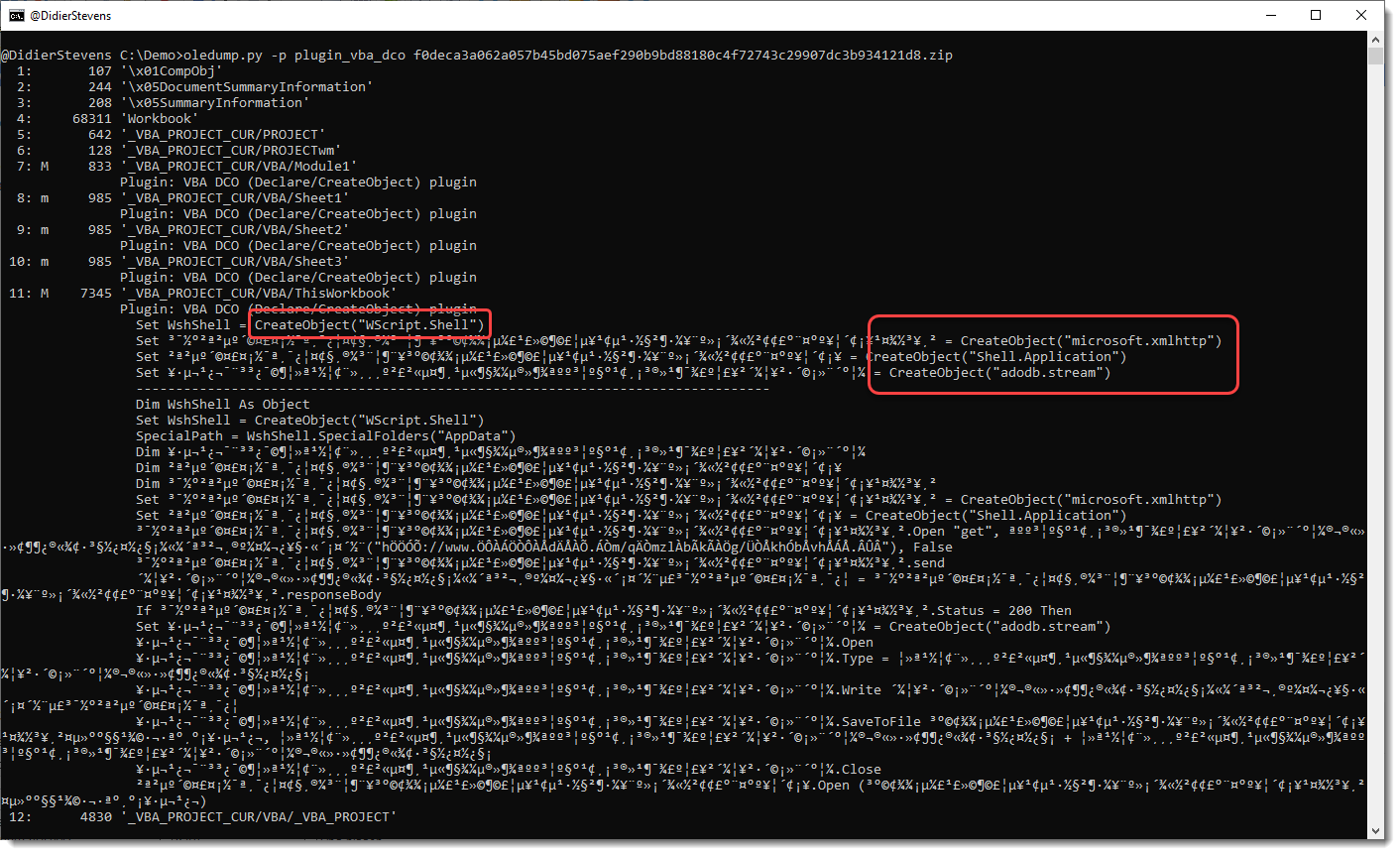
You can see the CreateObject functions, but appart from the WshShell identifier, the other identifiers don’t have letters and are hard to trace in the code.

This changes when you use option -g:
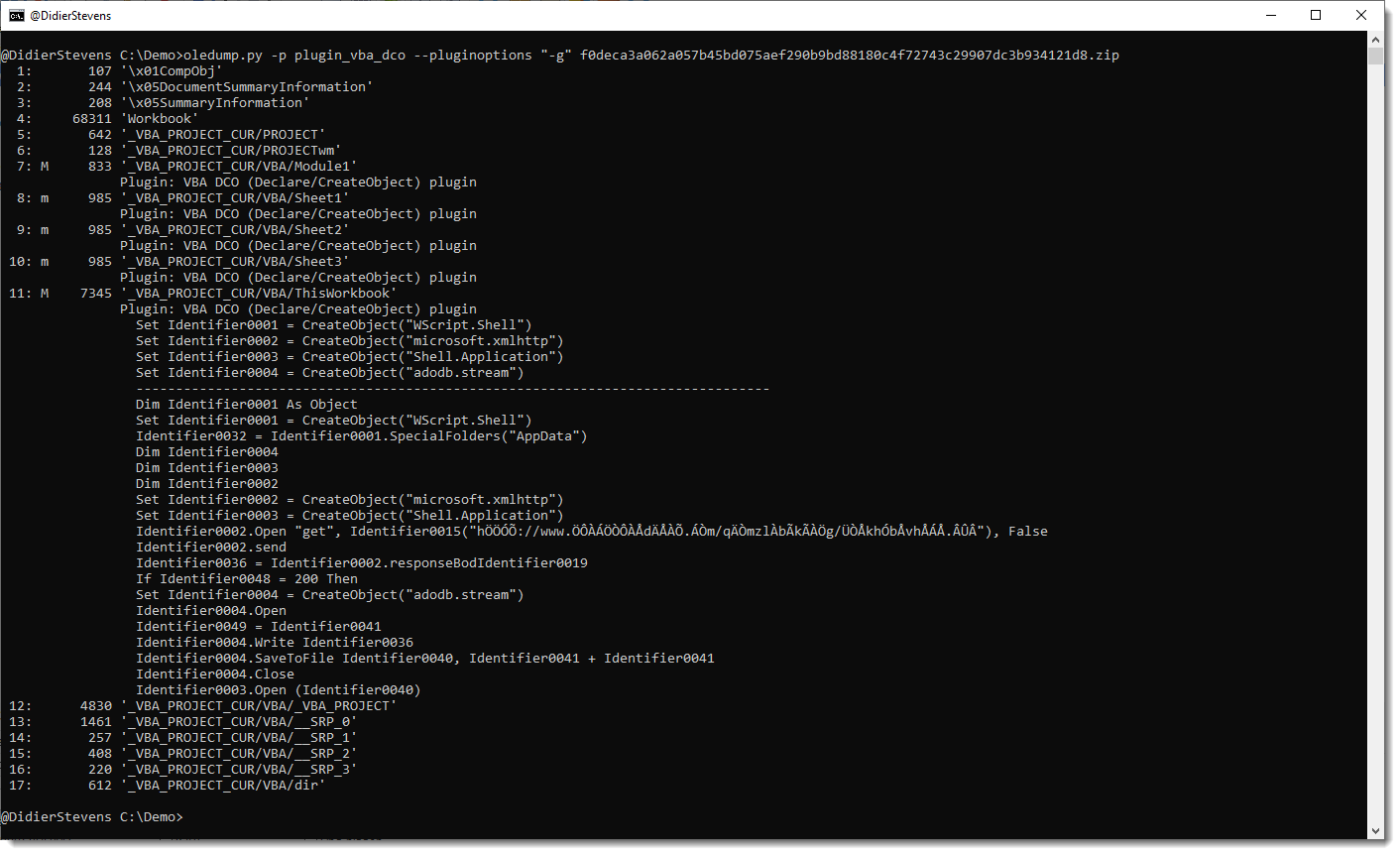
All identifiers have been generalized to names like Identifier0001, Identifier0002, …

To view all generalized code (and not only the lines with keywords), use option -a:
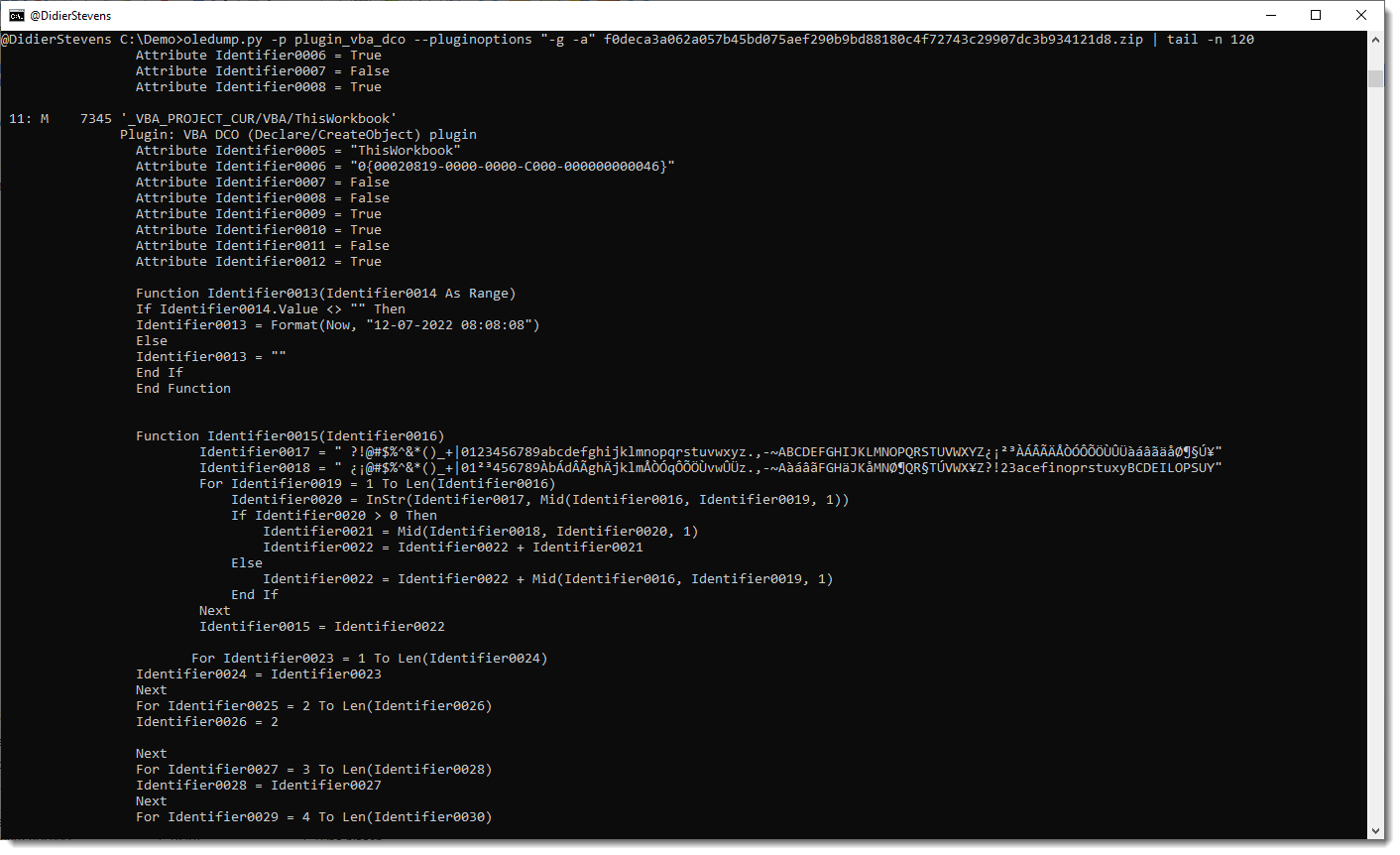
Remark that this plugin is not a VBA parser: it uses some simple scans and regexes to find identifiers. For example, it handles line comments like any other lines.

oledump_V0_0_69.zip (http)
MD5: 9FDE05EB0B475C5BB76A92A926DBE8CD
SHA256: 16761C633DEC83CB691AE7223BB5AE82E5EC668F5D161499800638BC45420285
Wednesday 20 July 2022

Update: sortcanon Version 0.0.2

Filed under: Uncategorized — Didier Stevens @ 0:00

This new version adds a sort function to sort email addresses by domain first.

sortcanon_V0_0_2.zip (http)
MD5: ED6DBE384707778E765C9BD6B6880C05
SHA256: 190922F347AC1B32D0CE503D1763F27A250D9BFDD15CB911EA4435BAB7E69CD3

Tuesday 19 July 2022

Update: base64dump.py Version 0.0.23

Filed under: My Software,Update — Didier Stevens @ 0:00

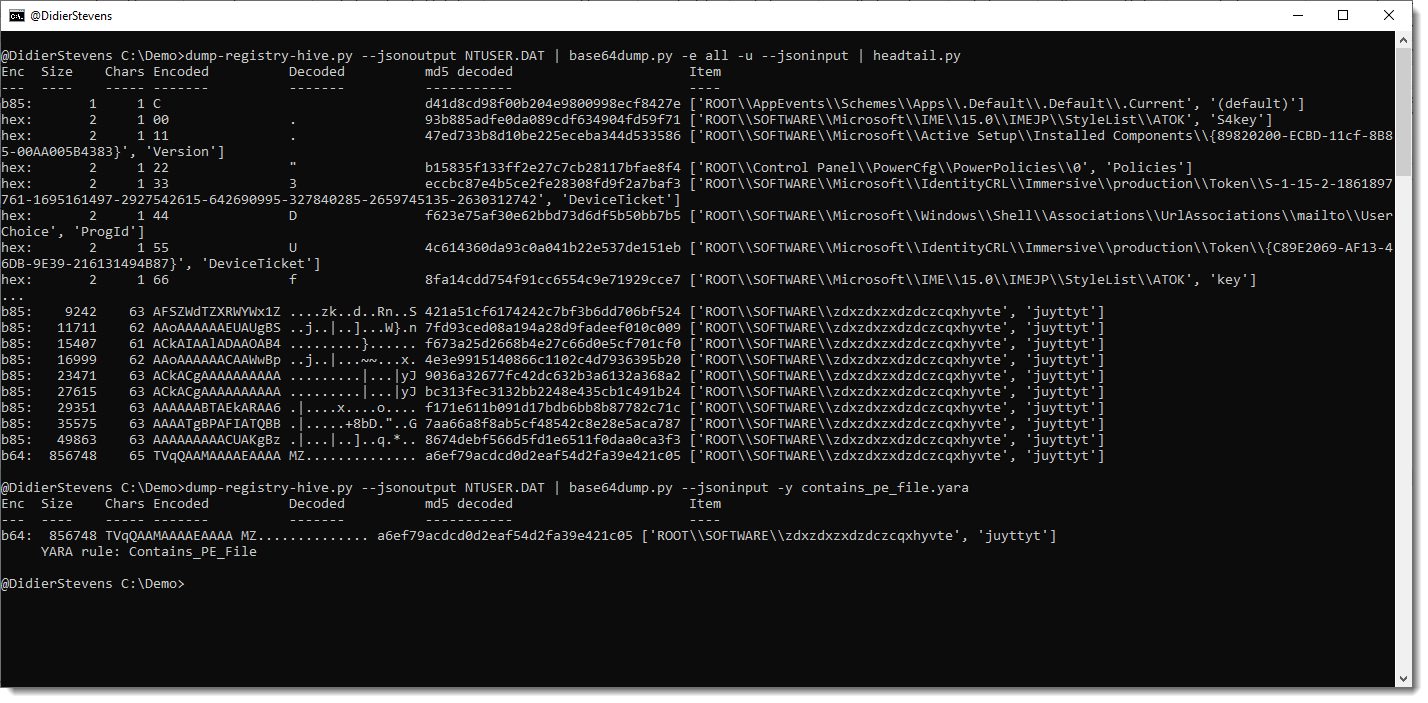
This new version adds JSON input support, allowing,for example, to detect encoded payloads inside the registry:

More info in an upcoming blog post.

base64dump_V0_0_23.zip (http)
MD5: 00D1E2344A6D09D3A2F18FC257F77090
SHA256: E4CA046198E801DFF309D6A8B346D5084FB4B4DFBFD339C5BCB3EF570CD08A79

Tuesday 12 July 2022

Quickpost: Standby Power Consumption Of My USB Chargers

Filed under: Hardware,Quickpost — Didier Stevens @ 0:00

I did some tests with my USB chargers: how much power do they consume when plugged into a power socket without charging any device (standby)?

The devices I tested are:

  1. Apple A1357
  2. Apple A2347
  3. Anker A2053
  4. No-brand: Chacon EMP604USB

I connected each one to a powermeter and let it measure the standby power consumption for 24 hours.

This is the result:

Model24 hours (Wh)1 hour (Wh)1 year (Wh)
Apple A13572,88470,12021052,9155
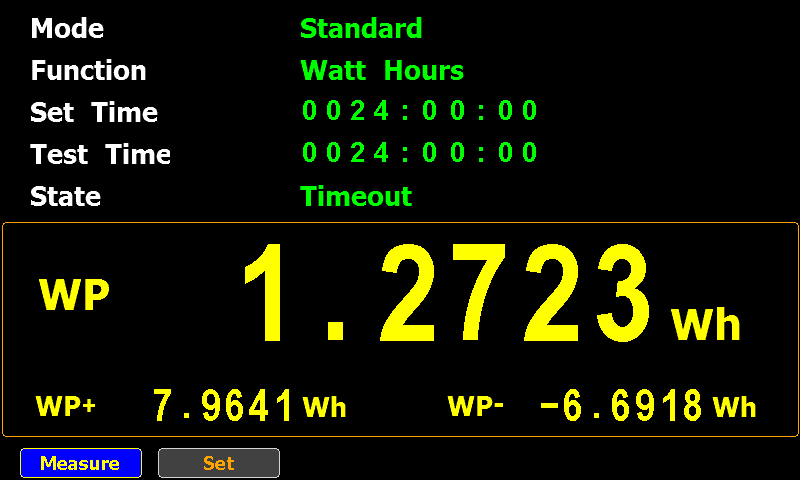
Apple A23471,27230,0530464,3895
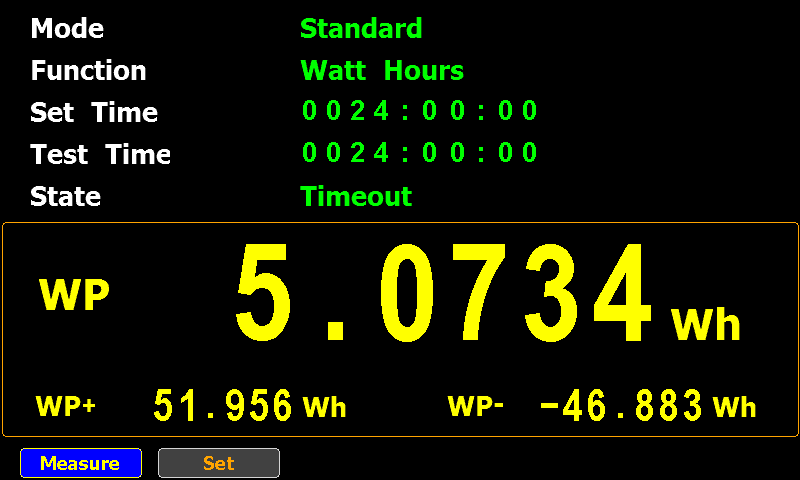
Anker A20535,07340,21141851,7910
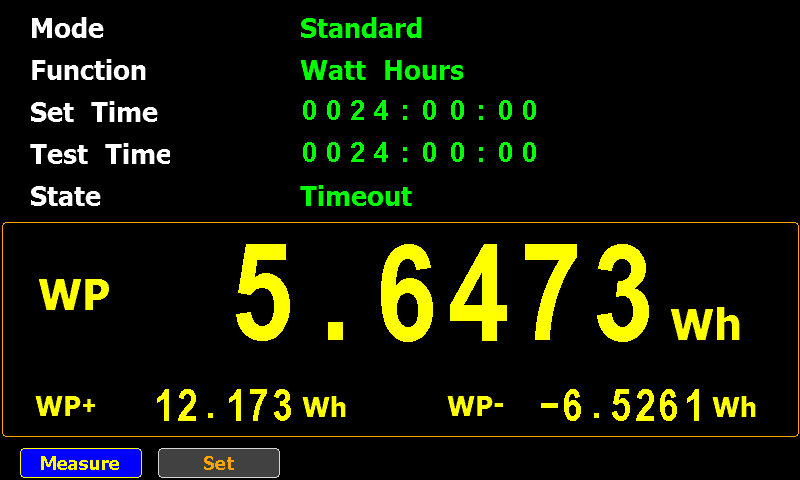
No-brand: Chacon EMP604USB5,64730,23532061,2645

24 hours is the measured data, the “1 hour” and “1 year” columns are calculated based on the 24 hours data.

The no-brand USB charger consumes the most: around 2 kWh per year, which is still less than a switched off Philips Hue lamp.

Using the same cost as for the Philips Hue lamp, that no-brand charger costs me around €1 if I would leave it plugged in for a whole year without letting it charge anything.


Quickpost info

Saturday 9 July 2022

simple_listener.py

Filed under: Announcement,My Software — Didier Stevens @ 21:05

This is the release of simple_listener.py, a Python program that can accept TCP and UDP connections and react according to its configuration. It has evolved from my beta program tcp-honeypot.py, that I will no longer maintain.

Everything you could do with tcp-honeypot, can be done with simple_listener.

I use simple_listener now whenever I need a server that listens for incoming TCP and/or UDP connections. For example, I have a configuration that can accept connections from Cobalt Strike beacons using leaked private keys.

simple_listener has a full man page, explaining all configuration items and options.

simple_listener_v0_1_2.zip (http)
MD5: 8F79FCB51EE2C1EB20B0F30F022EAE47
SHA256: F0EED539775AF36FFEB9B91529AF852C833D6A2764A9B9C65998AEA577F08175

Friday 1 July 2022

Overview of Content Published in June

Filed under: Announcement — Didier Stevens @ 0:00
Here is an overview of content I published in June:

Blog posts: YouTube videos: Videoblog posts: SANS ISC Diary entries:

Wednesday 29 June 2022

Update: format-bytes.py Version 0.0.14

Filed under: My Software,Update — Didier Stevens @ 0:00

This new version of format-bytes.py adds a feature to search for a range of integers:

#iv5#6080 means: look for an integer (i) equal to 6080 with a variation of 5 (v5), e.g., look for integers between 6075 and 6085.

format-bytes_V0_0_14.zip (http)
MD5: 600969FAC1F397036673574EA0BE0EE1
SHA256: D0EB0709985A4A5FEC1DA4B420CA440FF5268229CFFA1B3CC1EE5FAE92101957

Tuesday 28 June 2022

Update: cut-bytes.py Version 0.0.15

Filed under: My Software,Update — Didier Stevens @ 0:00

This new version contains a Python 3 fix.

cut-bytes_V0_0_15.zip (http)
MD5: 1906873950C1DC55665072C7F3529D7F
SHA256: 2B9847E49C08021C61B8FA09C9DD400FC41E817F65E1C2BAC64ABBD87D49E238

Monday 27 June 2022

Quickpost: Cracking PDF Owner Passwords

Filed under: Encryption,PDF — Didier Stevens @ 0:00

I added code to John the Ripper to crack PDF owner passwords (JtR cracks PDF user passwords only).

Source code can be found here.

Compiled Windows (Cygwin) and Linux (Ubuntu) executables can be found here.

This change introduces a new format: $pdfo$.

There is no tool for the moment to create this format. Just use pdf2john.pl to create a $pdf$ hash, and then change it into a $pdfo$ hash. To crack the owner password, one needs to recover the user password first.

This is the illustrated process:

There will be a PR for this change.

Cracking PDF owner passwords is just an academic exercise (writing this code was also just an exercise), as tools like QPDF can decrypt PDFs encrypted with a PDF owner password only without requiring the cleartext PDF owner password as argument.


Quickpost info

Wednesday 22 June 2022

Examples Of Encoding Reversing

Filed under: Forensics,Malware,Reverse Engineering — Didier Stevens @ 15:08

I recently created 2 blog posts with corresponding videos for the reversing of encodings.

The first one is on the ISC diary: “Decoding Obfuscated BASE64 Statistically“. The payload is encoded with a variation of BASE64, and I show how to analyze the encoded payload to figure out how to decode it.

And this is the video for this diary entry:

And on this blog, I have another example, more complex, where the encoding is a variation of hexadecimal encoding, with some obfuscation: “Another Exercise In Encoding Reversing“.

And here is the video:

« Previous PageNext Page »

Blog at WordPress.com.