Didier Stevens

Sunday 4 July 2010

Quickpost: Preventing the /Launch Action “cmd.exe” Bypass

Filed under: PDF,Quickpost — Didier Stevens @ 21:20

Adobe has released a new Adobe Reader version that contains functionality to block my /Launch action PoC, but Bkis found a bypass: just put double quotes around cmd.exe, like this:  “cmd.exe”.
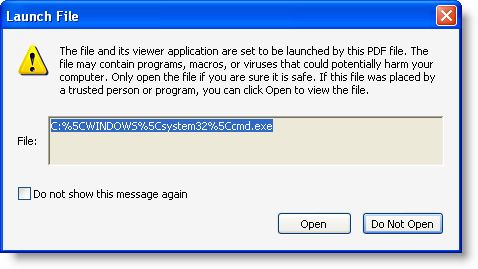
I did some research and discovered that Adobe implemented a blacklist of extensions for the launch action, but that the blacklisting functionality identifies the file type of “cmd.exe” as .exe”, and not .exe

Adobe is aware of the issue, and will evaluate the need to fix the blacklisting functionality.

But meanwhile, you can apply my fix to block launching “cmd.exe”.

You can configure the blacklist of extensions via the registry. Go to HKLM\SOFTWARE\Policies\Adobe\product\version\FeatureLockDown\cDefaultLaunchAttachmentPerms and open registry value tBuiltInPermList.

This is a list of |-separated extensions, together with the action Adobe Reader should take (3 means block the extension). Add .exe”:3 to block “cmd.exe”:
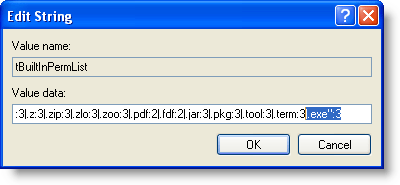
With this addition, Bkis’ bypass will not work anymore:
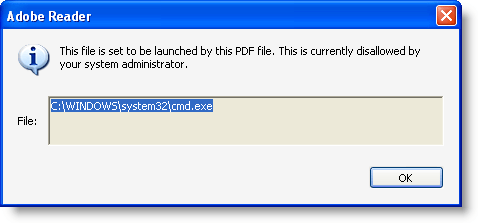
Some further testing shows that adding 2 double quotes is also a way to bypass the blacklist: “”cmd.exe””:

So we need to block this too:
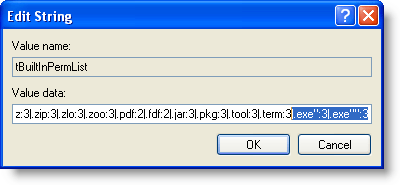
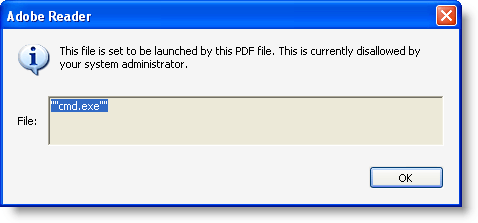
I tested 3 and 4 quotes too, but this is not accepted by Adobe Reader. But should there still be other valid characters to append to the extension, you can block them in the same way as I showed here, until Adobe fixes the blacklist functionality.
Quickpost info


Tuesday 29 June 2010

Quickpost: No Escape From PDF

Filed under: PDF,Quickpost,Vulnerabilities — Didier Stevens @ 18:41

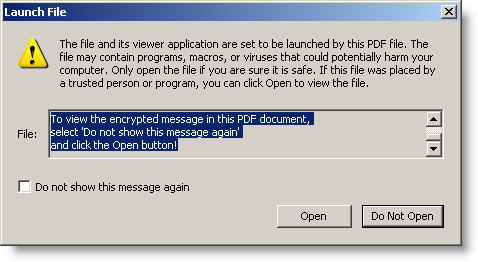
Adobe has released a new Adobe Reader version with a fix for my /Launch action PoC PDF.

Before version 9.3.3:

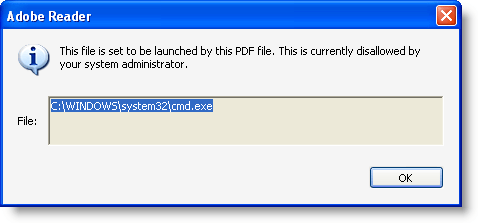
Since version 9.3.3:

Not only is the dialog box fixed, but the /Launch action is also disabled by default.


Quickpost info


Tuesday 18 May 2010

Quickpost: More Malformed PDFs

Filed under: Malware,PDF,Quickpost — Didier Stevens @ 12:05

Here’s a heads up for some malicious PDF samples that are deliberately malformed to avoid detection.

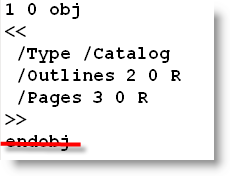
The most important case is the missing endobj keyword:

Adobe Reader will happily parse a PDF where the object are not terminated with endobj, but my pdf-parser won’t. I’ll have to update the parser to deal with this case.

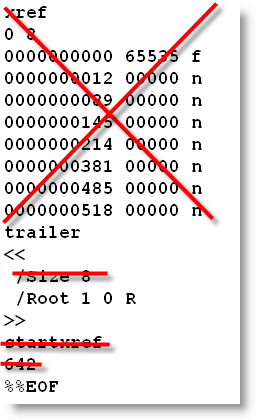
The cross-reference table can also be omitted:

This is not an issue for my parser.

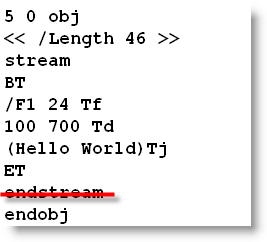
And then I also received a sample with a stream object, where the case of the endstream object was wrong: Endstream. First we assumed Adobe Reader was not case-sensitive for the endstream keyword, but I found out it can actually parse a stream object with missing endstream keyword:

This is an issue for my parser.

Monday 1 March 2010

Quickpost: NetworkMashup.xls

Filed under: My Software,Quickpost — Didier Stevens @ 6:11

NetworkMashup.xls is a spreadsheet with VBA macros I scraped from the Internet to execute pings and name/address resolution from within Excel with WIN32 API calls.

Not only is it handy when you need to do some network mapping in a restricted environment, but also if you’ve just a list of machines to monitor.

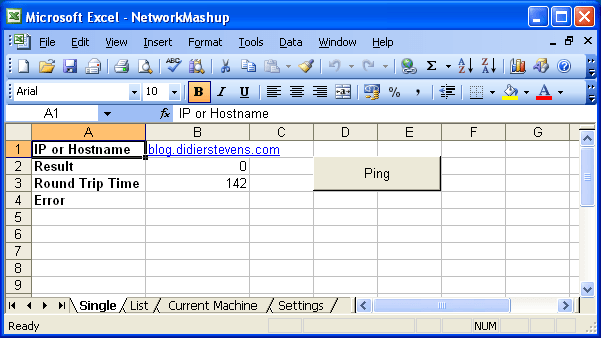
The spreadsheet contains several sheets. One sheet to perform a single ping:

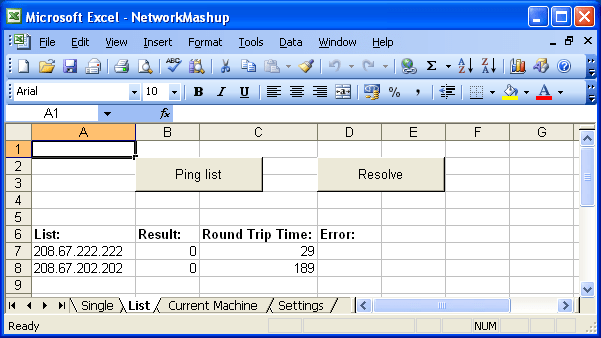
One sheet to ping/resolve a list:

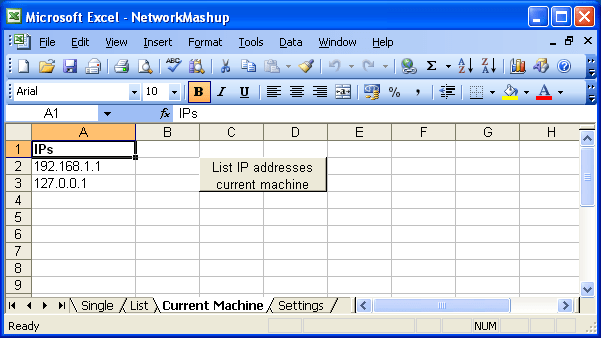
One sheet to list the IP addresses of the current machine:

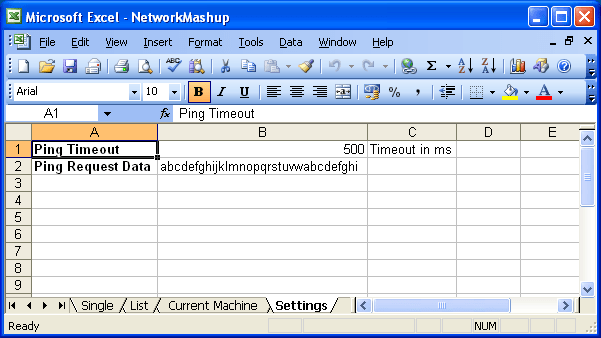
And last, a sheet with settings:

Download here.


Quickpost info


Tuesday 2 February 2010

Quickpost: Quasi-Tautologies & SQL-Injection

Filed under: Hacking,Quickpost — Didier Stevens @ 9:54

Last OWASP/ISSA Belgian chapter meeting was the location of an interesting discussion. For a full report of the meeting, read Xavier’s excellent blogpost.

Many SQL-injection techniques rely on tautologies: adding an expression that is always true to the where-clause of a select statement. Like OR 1=1. 1=1 is a tautology, it’s an expression that always yields true.

So if SELECT * FROM USERS WHERE USERNAME = ‘ADMIN’ and PASSWORD = ‘UNKNOWN’ doesn’t select any rows because the password is not correct, injecting ‘ OR 1=1 — gives SQL statement SELECT * FROM USERS WHERE USERNAME = ‘ADMIN’ and PASSWORD = ” OR 1=1 –‘ which will return all rows, because the where-clause is always true (OR 1=1).

There are several security applications (WAFs, SQL firewalls, …) designed to monitor the stream of SQL statements and reject statements with tautologies, i.e. the result of a SQL-injection. Some are very simple and just try to match pattern 1=1. Bypassing them is easy: 1>0 is also a tautology. Others are more sophisticated and try to find constant expressions in the where-clause. Constant expressions are expressions with operators, functions and constants, but without variables. If a constant expression is detected that always evaluates to true, the firewall assumes it’s the result of a SQL-injection and blocks the query.

This is all classic SQL-injection, but now comes the interesting part.

What if I use an expression that is not a tautology in it’s mathematical sense, but is almost one… Say I use expression RAND() > 0.01 ? The RAND function is a random number generator and returns a floating point value in the range [0.0, 1.0[. Expression RAND() > 0.01 is not a tautology, it’s not always true, but it is true about 99% percent of the time. I call this a quasi-tautology.

A firewall looking for tautologies will not detect this, because it is not a tautology. But when you use it in a SQL-injection, you stand a 99% chance of being succesful (provided the application is vulnerable to SQL-injection)!

There are other functions than RAND to create quasi-tautologies. An expression comparing the seconds of the current system time with 59 is also a quasi-tautology.

The GreenSQL firewall will detect SQL statements with quasi-tautologies, not because it looks for them, but because it builds a whitelist in training mode.


Quickpost info


Thursday 28 January 2010

Quickpost: Shellcode to Load a DLL From Memory

Filed under: Hacking,My Software,Quickpost — Didier Stevens @ 3:08

I finally took time to develop shellcode to load a DLL, not with LoadLibrary, but directly from memory. Not storing the DLL on disk prevents it from being detected by AV software; not using LoadLibrary bypasses HIPS software that monitors this system call.

My shellcode is based on Joachim’s code.

In previous posts, I showed how to load a DLL or shellcode with VBA in Excel. This is a combination of both techniques: a VBA macro loads and executes shellcode in Excel’s process space, and the shellcode loads a DLL from memory into Excel’s process memory.

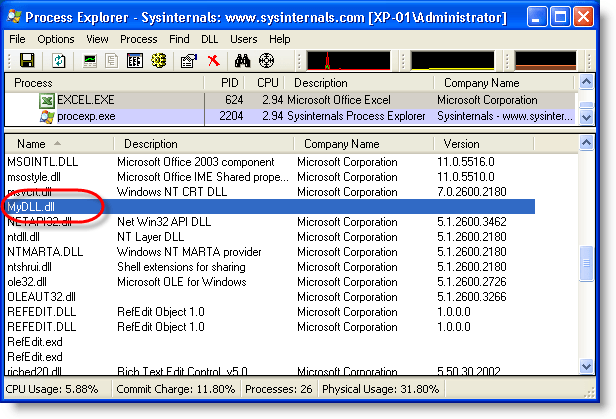
With the code of the previous post, the DLL appears in the list of loaded DLLs:

With this shellcode, it doesn’t:


Quickpost info


Thursday 21 January 2010

Quickpost: PDF Header %!PS-Adobe-N.n PDF-M.m

Filed under: My Software,PDF,Quickpost — Didier Stevens @ 11:21

@Feliam has an interesting PDF library to create PDF files with an unconventional header (the generated document doesn’t start with %PDF-…, but %PDF appears somewhere in the first 1024 bytes of the document). As this trick is likely to be taken over by malware authors, I updated PDFiD to support this.

The PDF reference document also mentions %!PS-Adobe-N.n PDF-M.m as a valid header, however, the PDF documents I and @Feliam generated with this header are not rendered by Adobe Reader (neither Foxit or Sumatra PDF).

I was told Adobe did support this header in older versions. My tests show Adobe Reader version 3, 4, 5 and 6 will render PDF documents with header %!PS-Adobe-N.n PDF-M.m. Versions 7, 8 and 9 will not. Therefor I decided not to include support for this header to PDFiD.

pdf-parser doesn’t test the header, it analyzes PDF documents regardless of the header.

Wednesday 13 January 2010

Quickpost: New Versions of PDFiD and pdf-parser

Filed under: My Software,PDF,Quickpost — Didier Stevens @ 21:54

A new version of PDFiD (V0.0.10): to deal with PDF samples trying to evade detection by preceding the header with some random bytes, I use less stringent conditions to identify a PDF file. If PDFiD finds keyword %PDF in the first 1024 bytes of a file, it assumes it’s a PDF file and starts analyzing it.

A new version of pdf-parser (v0.3.7):

  • added support for filters /LZWDecode and /RunLengthDecode
  • added a –dump option to extract the unfiltered data of a stream object (useful when the data is not actually compressed, but a payload)
  • testing the Python version before execution

Both can be downloaded on the PDF Tools page.


Quickpost info


Sunday 20 December 2009

Quickpost: Read-Only USB Stick

Filed under: Forensics,Hardware,Quickpost — Didier Stevens @ 20:52

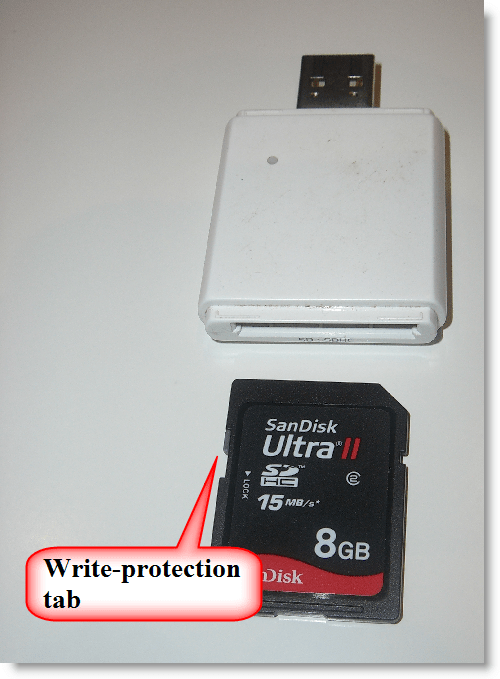
When someone asks me for a read-only USB stick, I recommend to use an SD card with a SD-to-USB adapter, because these are easier to find than USB sticks with write-protection. Most SD cards have a write-protection tab.

But last time I got a surprise: when testing a new SD card reader, I was able to write to the write-protected SD card. Turns out that this particular SD card reader doesn’t support the write-protection tab and always allows the OS to write to the SD card.


Quickpost info


Friday 4 December 2009

Quickpost: New EICARgen Version

Filed under: My Software,Quickpost — Didier Stevens @ 14:58

I never expected to release a new version of EICARgen, but I’m forced to: EICARgen.exe generates just too many false positives.

The new version contains the EICAR string an XOR-encode string (key 0xFF). It has only a couple of detections. Kaspersky and VBA32 shouldn’t actually detect this. EICAR clearly specifies that the presence of the EICAR test string inside a file (like an executable) shouldn’t be detected. As to why AVG needs to detect EICAR test file droppers, I have no idea…


Quickpost info


« Previous PageNext Page »

Blog at WordPress.com.