Didier Stevens

Tuesday 26 April 2016

Update translate.py Version 2.3.0

Filed under: My Software,Update — Didier Stevens @ 0:00

In this update of my translate program, I added support for searching and replacing with regular expressions.

Option -r (regex) uses a regular expression to search through the file and then calls the provided function with a match argument for each matched string. The return value of the function (a string) is used to replace the matched string.
Option -R (filterregex) is similar to option -r (regex), except that it does not operate on the complete file, but on the file filtered for the regex.

Here are 2 examples with a regex. The input file (test-ah.txt) contains the following: 1234&H41&H42&H43&H444321

The first command will search for strings &Hxx and replace them with the character represented in ASCII by hexadecimal number xx:
translate.py -r “&H(..)” test-ah.txt “lambda m: chr(int(m.groups()[0], 16))”
Output: 1234ABCD4321

The second command is exactly the same as the first command, except that it uses option -R in stead or -r:
translate.py -R “&H(..)” test-ah.txt “lambda m: chr(int(m.groups()[0], 16))”
Output: ABCD

In this output, strings that do not match the regular expression are filtered out.

translate_v2_3_0.zip (https)
MD5: 3C21675A2792DCBAF2EB0222C3D14450
SHA256: B51D4D47213AE7E79E3C9D157F5FC8E26C41AB9A5F3A26CD589F588C03910F2A

Monday 18 April 2016

Update: decode-vbe.py Version 0.0.2

Filed under: My Software,Update — Didier Stevens @ 8:48

I added support for ZIP files to decode-vbe.py

Here is the man page:

Usage: decode-vbe.py [options] [file]
Decode VBE script

Options:
–version   show program’s version number and exit
-h, –help  show this help message and exit
-m, –man   Print manual

Manual:

This program reads from the given file or standard input, and converts the encoded VBE script to VBS.

The provided file can be a password protected ZIP file (with password infected) containing the VBE script.

The content of the VBE script can also be passed as a literal argument. This is similar to a Here Document in Unix.
Start the argument (the “filename”) with character # to pass a literal argument.
Example: decode-vbe.py “##@~^DgAAAA==\ko$K6,JCV^GJqAQAAA==^#~@”
Result: MsgBox “Hello”

It’s also possible to use hexadecimal (prefix #h#) or base64 (prefix #b#) to pass a literal argument.
Example: decode-vbe.py #h#23407E5E4467414141413D3D5C6B6F244B362C4A437F565E474A7141514141413D3D5E237E40
Result: MsgBox “Hello”
Example: decode-vbe.py #b#I0B+XkRnQUFBQT09XGtvJEs2LEpDf1ZeR0pxQVFBQUE9PV4jfkA=
Result: MsgBox “Hello”

decode-vbe_V0_0_2.zip (https)
MD5: 35612087E2D62669E2690573FDE543F2
SHA256: 91A7465FE1F4D291751E6C5D88C51888C914B40C6F187709E33343FF121A116F

Tuesday 29 March 2016

Decoding VBE

Filed under: My Software — Didier Stevens @ 0:01

I wrote a Python program to decode encoded VBS scripts (VBE).

20160328-223229

decode-vbe_V0_0_1.zip (https)
MD5: 87E61217BC77275DBACEA77B8EDF12B5
SHA256: 11A9B5D47657C123845007E3E29FB331CAE7483B6A4A3AC54276DB90116911B5

Tuesday 22 March 2016

YARA Rule To Detect VBE Scripts

Filed under: maldoc,Malware,My Software — Didier Stevens @ 0:00

Malicious documents that drop VBE scripts (VBScript Encode scripts) are in the wild. Here is an example:

20160321-214635

20160321-214711

I have a YARA rule to detect VBE scripts:

20160321-214305

20160321-214346

20160321-214502

yara-rules-V0.0.6.zip (https)
MD5: 01CB37759AC30EEA8D2B66226609C73E
SHA256: 1B56C1D7D0E1A8F500674B74F93F3E7DE6B2EFC85259ABE3A57F1DCA458CCFF8

Friday 11 March 2016

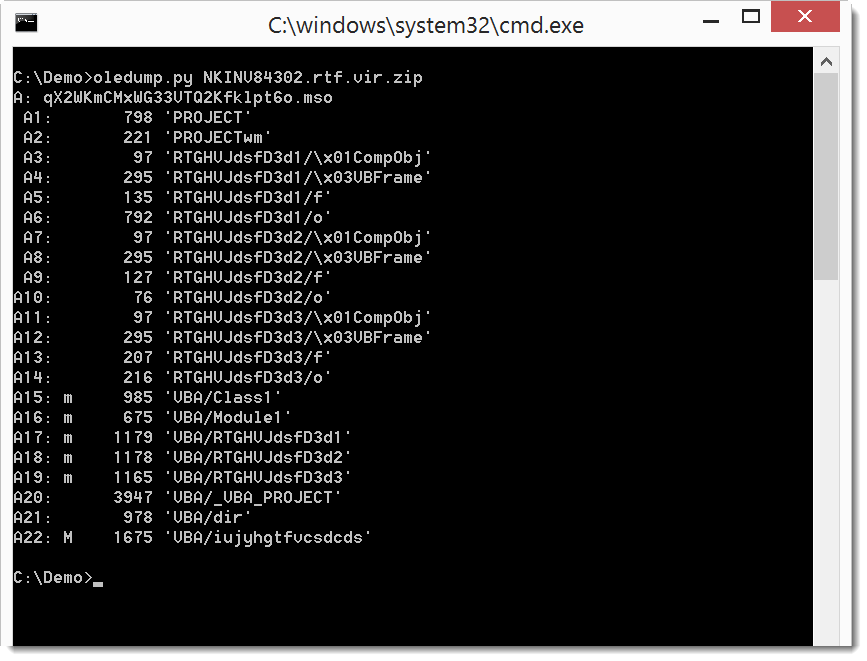
Update: oledump.py Version 0.0.23

Filed under: maldoc,Malware,My Software,Update — Didier Stevens @ 9:44

I’m providing a 2-day training at Brucon Spring Training 2016: “Analysing Malicious Documents“. Use promo-code SPRING16 for a 10% discount.

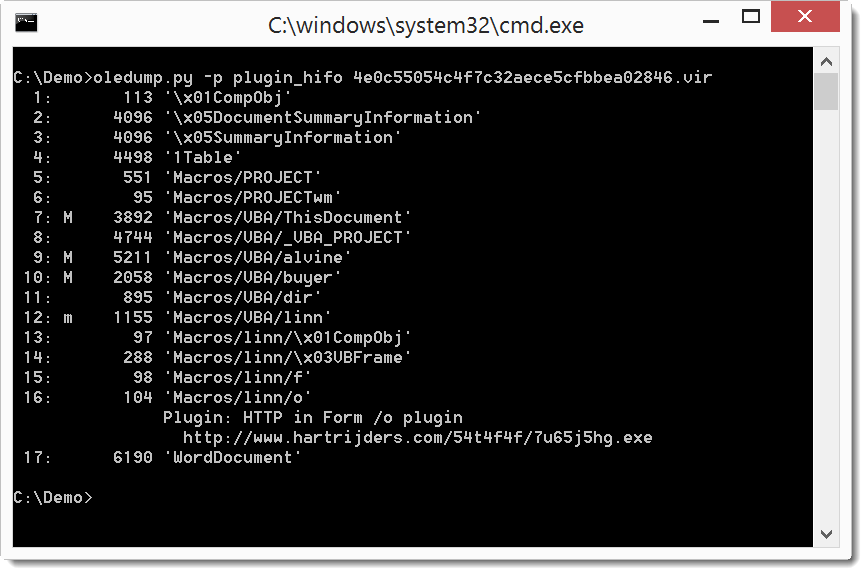
This new version of oledump brings an update to the –cut option and a new plugin: plugin_hifo.

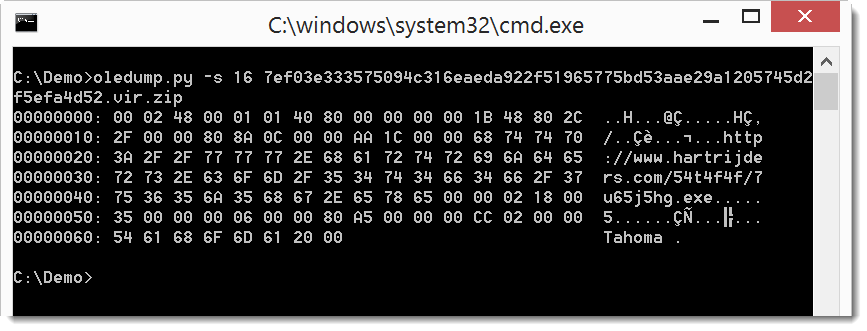
As I documented in this ISC Diary entry, maldocs can store URLs in properties of userforms:

20160221-185714

The plugin plugin_hifo is a simple plugin that looks for streams that end with /o and then searches for strings starting with http (hence the name: http in form /o).

20160311-103509

oledump_V0_0_23.zip (https)
MD5: 991910FF4AA47808A5BBCE0CC109D41A
SHA256: 612B6FD06856C7790D2F66B29286E7B89D35D8354ADB167CA512CC1CDE3F6C47

Saturday 5 March 2016

Even More Obfuscated MIME Type Files

Filed under: maldoc,Malware,My Software,Update — Didier Stevens @ 9:45

I’m providing a 2-day training at Brucon Spring Training 2016: “Analysing Malicious Documents“. Use promo-code SPRING16 for a 10% discount.

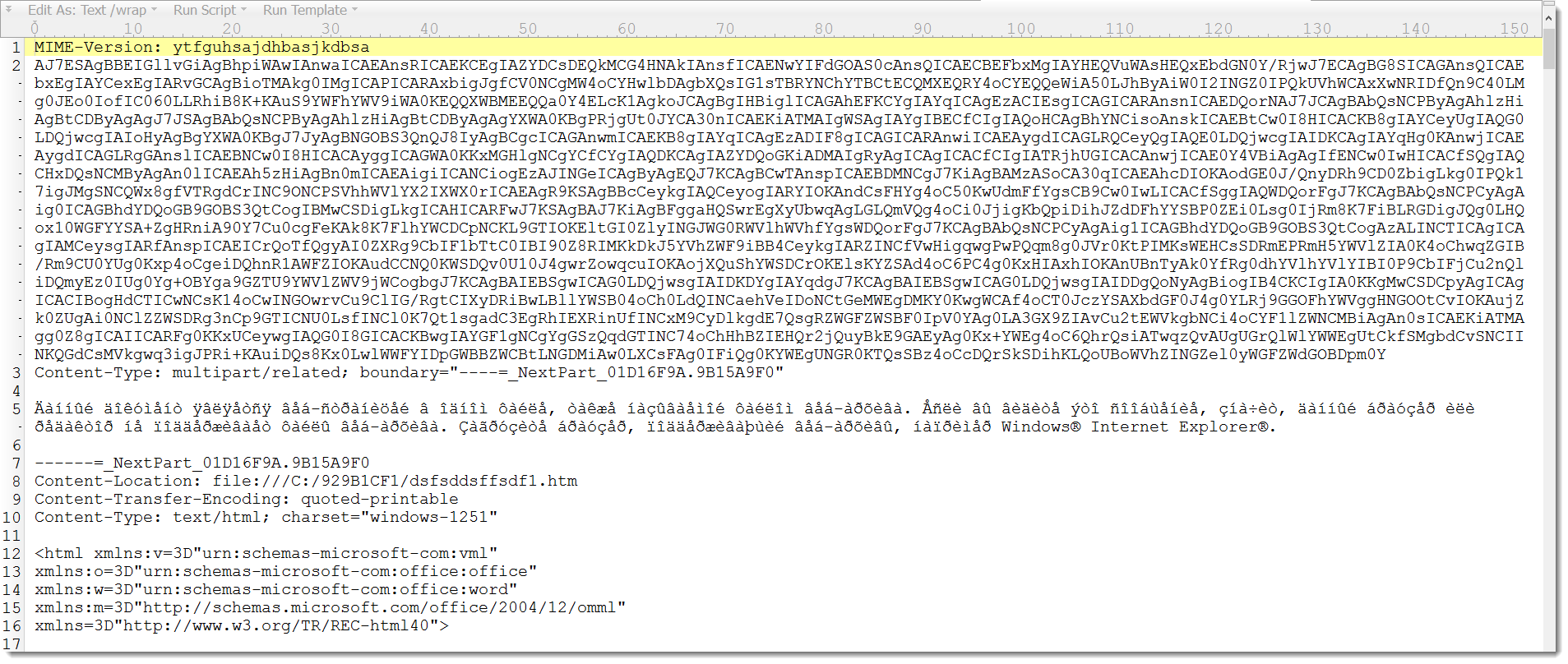
I received another maldoc sample (MD5 73D06B898E03395DA3D60D11E49751CC):

20160305-102423

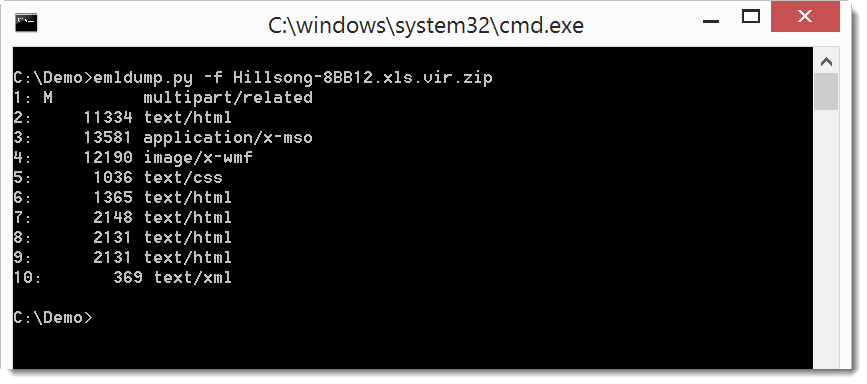
Lines 2, 3, 6, 7 and 8 are there to obfuscate this MIME type file. emldump.py now detects all lines without a colon in the first block (all lines before the empty line 9: 1 – 8).

20160305-103000

You can filter out these lines with option -f:

20160305-103136

emldump_V0_0_8.zip (https)
MD5: B6FBAF2AB403AFE30F7C3D7CA166793B
SHA256: 7A7016B29F291C3D42B43D43B265DAD86B96DA519DB426163CC2D15C556896E3

Monday 29 February 2016

More Obfuscated MIME Type Files

Filed under: maldoc,Malware,My Software,Update — Didier Stevens @ 20:57

I’m providing a 2-day training at Brucon Spring Training 2016: “Analysing Malicious Documents“. Use promo-code SPRING16 for a 10% discount.

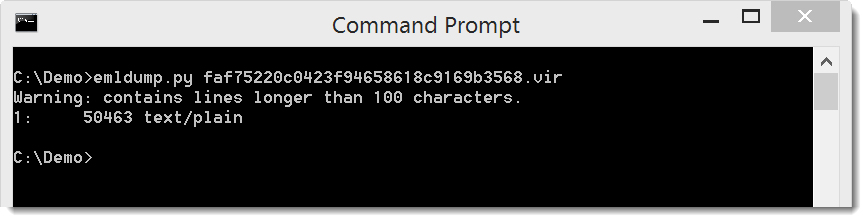
I received a maldoc sample (MD5 FAF75220C0423F94658618C9169B3568):

20160229-213357

You can see it’s a MIME Type file, and that it is obfuscated. The second line is a very long line of seemingly random letters and digits. This throws of Python’s MIME parser used by my emldump tool:

20160229-214123

emldump just detects this as a text file, and not as a multipart MIME Type file.

If we remove that second line, for example with findstr /v (or grep -v), emldump recognizes the different parts:

20160229-214500

Since obfuscated MIME Type files are becoming more and more prevalent, I’m adding a filter option to emldump to filter out lines that obfuscate the MIME Type files. For the moment, option -f throws out lines longer than 100 characters and header lines that are not fields (just like option -H).

This new version of emldump.py detects some (simple) types of obfuscation:

20160229-215458

And with option -f you can filter out these obfuscating lines:

20160229-215704

Download:

emldump_V0_0_7.zip (https)
MD5: 819D4AF55F556B2AF08DCFB3F7A8C878
SHA256: D5C7C2A1DD3744CB0F50EEDFA727FF0487A32330FF5B7498349E4CB96E4AB284

Sunday 28 February 2016

Update: translate.py Version 2.2.0 for Locky JavaScript Deobfuscation

Filed under: maldoc,Malware,My Software,Update — Didier Stevens @ 10:45

Over at the ISC Diary I have an entry on Locky JavaScript Deobfuscation. I use my translate tool to perform part of the static analysis.

When you read this diary entry, you’ll see that I have to create 2 Python scripts to be used by translate.py to search with a regular expression and replace all matches with the output of a Python function.

I updated translate.py so that I don’t have to create Python scripts for this regex search-and-replace, but that I can do it from the command-line with a new option. This new option (-r, –regex) takes a regular expression and does a search-and-replace.

Here are the 2 “scripts” using this new option:

translate.py -r "\([^\\\(]+\\u([0-9a-f]{4})[a-z]+'\.e\(\)\)" "lambda oMatch: chr(39) + chr(int(oMatch.group(1), 16)) + chr(39)"
translate.py -r "('[^']*' ?\+ ?)+'[^']*'" "lambda oMatch: chr(39) + eval(oMatch.group(0)) + chr(39)"

If you just want to do a search-and-replace, you can use a constant regex and lambda function, like this (replace False with True):

translate.py -r "False" "lambda oMatch: 'True'"

translate_v2_2_0.zip (https)
MD5: D561D9987A3E5264E40A4B5C4057A732
SHA256: BC532BD5C7DD86DCADDF7B7B9A34453E983E226E103E0591E7D480BB43C350E0

Wednesday 10 February 2016

Create Your Own CMD.XLS

Filed under: Hacking,My Software — Didier Stevens @ 0:00

For several years now I’ve been using my modified cmd.exe from Excel.

20160209-232633

I’m not releasing this spreadsheet with my cmd code, but I release the VBA code. You can create your own spreadsheet (or Word document) with this VBA file. If you don’t know how, here’s a video:

Sunday 7 February 2016

Update: numbers-to-hex.py Version 0.0.2

Filed under: My Software,Update — Didier Stevens @ 9:21

A bugfix.

numbers-to-hex_V0_0_2.zip (https)
MD5: 911D2BF2EC0839DD595C48FF4BE5E979
SHA256: 41D5B19E401516CB134521E1F6973A16DBFE491303BD93429EEBE55C0B3AFEF6

« Previous PageNext Page »

Blog at WordPress.com.