Didier Stevens

Tuesday 12 June 2018

Update: pecheck.py Version 0.7.3

Filed under: My Software,Update — Didier Stevens @ 0:00

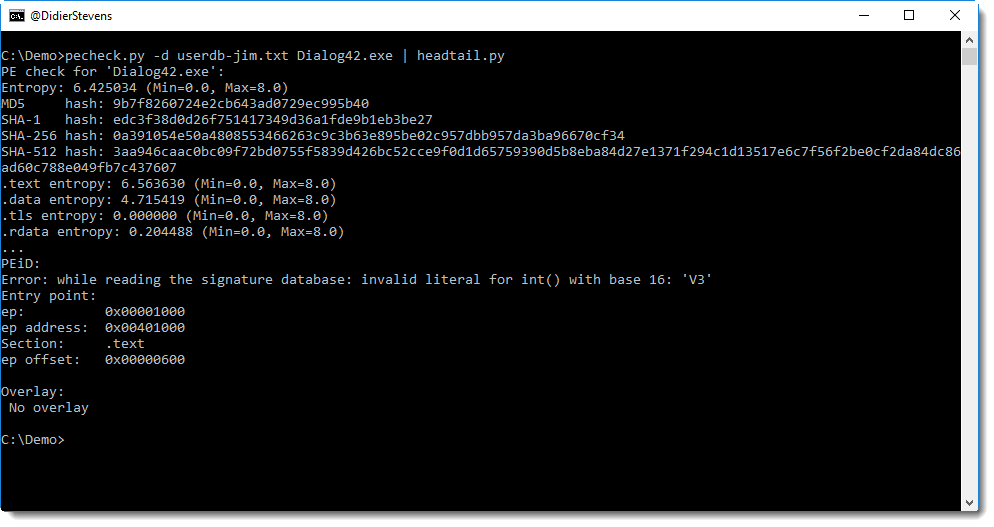
This new version handles errors in PEiD’s userdb files better.

pefile does not support the full syntax used by PEiD, hence errors might occur, like this:

pecheck-v0_7_3.zip (https)
MD5: 480C9AC4BEE09CAAFB1593E214A39832
SHA256: 359A44751BAA34450B2DA92539AB425507EBB90F8F57CF50E561CCE111809637

Thursday 31 May 2018

PDFiD: GoToE and GoToR Detection (“NTLM Credential Theft”)

Filed under: My Software,PDF — Didier Stevens @ 0:00

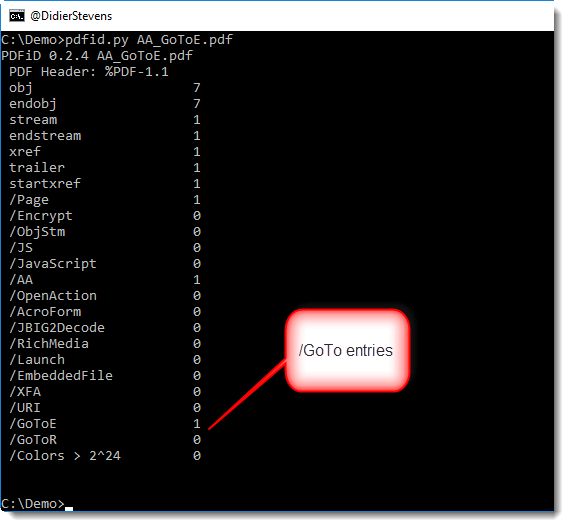
The article “NTLM Credentials Theft via PDF Files” explains how PDF documents can refer to a resource via UNC paths. This is done using  PDF names /GoToE or /GoToR.

My tool pdfid.py can now be extended to report /GoToE and /GoToR usage in a PDF file, without having to change the source code. You just have to edit the pdfid.ini file (or create it) to include these names, like this:

[keywords]
/URI
/GoToE
/GoToR

Using pdfid configured like this on a “credential stealing PDF” gives the following result:

pdfid.ini has to be located in the same directory as pdfid.py. And remember that names in the PDF language are case-sensitive.


Friday 25 May 2018

Update: base64dump.py Version 0.0.10

Filed under: My Software,Update — Didier Stevens @ 0:00

And even more encodings added to this version of base64dump.py: 0x…. little-endian (zxle) and 0x…. big endian (zxbe).

base64dump_V0_0_10.zip (https)
MD5: 6670ACD88FD384BA9172F2B98E72D0D4
SHA256: C080F2A5F60A8E9593AE789A69D233EFC86AEF9BD319C409229B3E518E15C725

Monday 21 May 2018

Video: SpiderMonkey Output Options

Filed under: My Software — Didier Stevens @ 10:43

I created a video to illustrate the new features of my modified SpiderMonkey version:

Tuesday 8 May 2018

Update: base64dump.py Version 0.0.9

Filed under: My Software,Update — Didier Stevens @ 0:00

During last week’s private maldoc training, I got the idea to update base64dump with 2 extra encodings, and add YARA support.

The new encodings are “bx = backslash hexadecimal” like \x90\x90… and “ah = ampersand hexadecimal” like &H90&H90…

Support for YARA rules is identical to my other tools, like oledump.

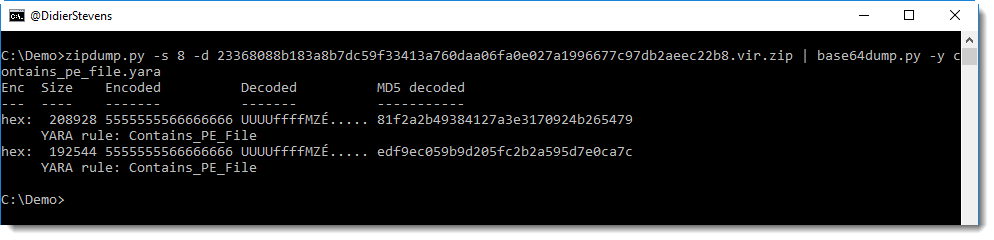
In this example, I use a YARA rule to detect hex-encoded PE files:


base64dump_V0_0_9.zip (https)
MD5: 4CF9F57AD34CC728B05F1307219864BB
SHA256: 01264F82CEFB7B1D2DF51A8DB190840FE6C368C9C3D63566CF14CE4983F73D5A

Sunday 6 May 2018

Update: oledump.py Version 0.0.34

Filed under: My Software,Update — Didier Stevens @ 17:05

Often when I provide training, I get new ideas. This week’s private maldoc training was no different: here’s a new version of oledump with changes inspired by this training.

When you select a stream with a prefix, like A3, you no longer have to type the prefix if it’s A (e.g. the first embedded OLE file).

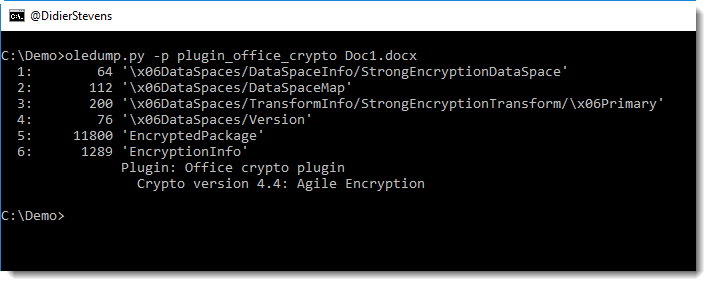
And I have a new plugin for encrypted documents (plugin_office_crypto.py), more on this in an upcoming blogpost.

oledump_V0_0_34.zip (https)
MD5: 1BE4E08DE1B1E73D5808AECE1BD09852
SHA256: 74F1B05E50D2AF8072505587438BB8959F174BAF76ED6255116E806642E6C4B0

Tuesday 24 April 2018

SpiderMonkey and STDIN

Filed under: Malware,My Software — Didier Stevens @ 0:00

With most of my tools, I try to support input via STDIN.

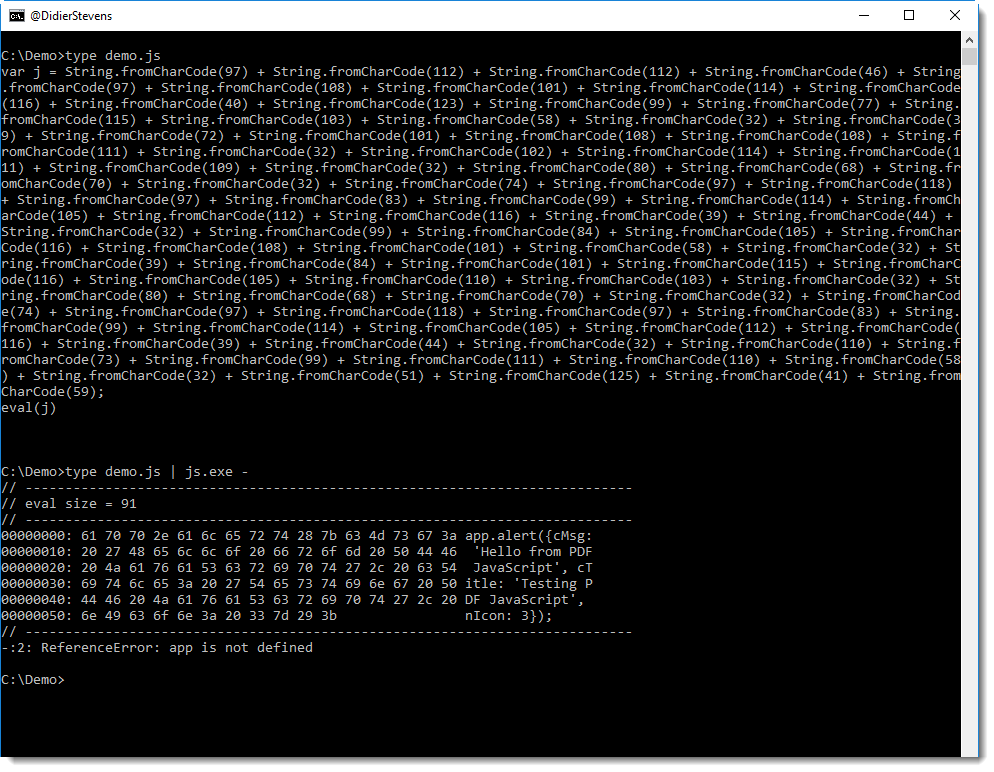
It’s also possible to provide JavaScript scripts for parsing to SpiderMonkey via STDIN. You can pass filename – to js for processing STDIN input:

I often store malware in password protected ZIP files, these files can be analyzed too provided you use zipdump.py:

And with option -e, it’s also possible to change output type via the command line:

Sunday 22 April 2018

Update: python-per-line.py Version 0.0.4

Filed under: My Software,Update — Didier Stevens @ 10:46

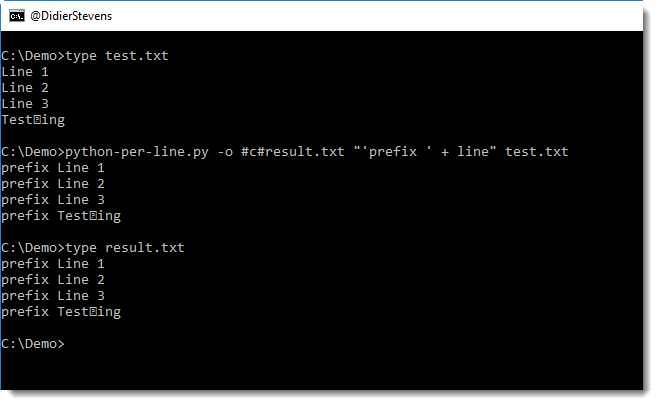
This new version brings new output features. For example, you can use the output option (-o) to output simultaneously to the console and a file:

Explanation:

-o result.txt will write the output to file result.txt, and nothing to the console

-o #c#result.txt will write the output to file result.txt and to the console

For all the details, consult the man page: python-per-line.py -m

python-per-line_V0_0_4.zip (https)
MD5: FE8E875E2A7B8CD89FCAAB3B5830206C
SHA256: 7A6DACBAFC13DDE164F2AAB49DA766613F23BE78FF9BCAF5392EEA01F71620D0

Thursday 19 April 2018

Update: Patched SpiderMonkey

Filed under: My Software,Update — Didier Stevens @ 0:00

I was showing a colleague how to use my patched SpiderMonkey to analyze obfuscated JavaScript, when I realized I had not yet released my latest version.

SpiderMonkey is an opensource JavaScript interpreter. I modified it to help with malware analysis. For example, my version will dump the argument of the eval function, and I’ve implemented document.write and window.navigate (dumping arguments too).

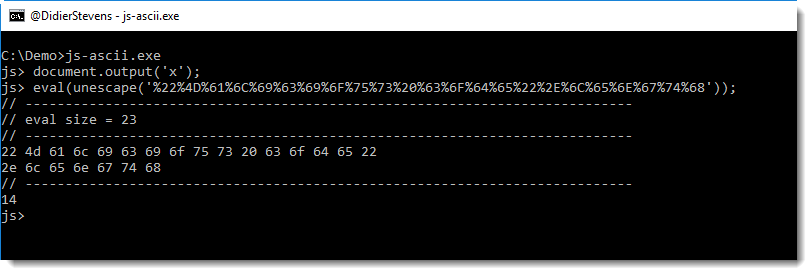
This latest version was developed a couple of years ago (that’s why it’s still based on SpiderMonkey 1.7) to dump arguments to stdout. Previous versions of my patched SpiderMonkey dump arguments to files, in this latest version, you can choose were to dump the arguments. A method was added to object document: document.output(arg). This output method takes one argument: a string. The following values may be used as argument:

  • ‘a’ ASCII/HEX dump
  • ‘x’ HEX dump
  • ‘d’ raw dump
  • ‘A’ pure ASCII/HEX dump
  • ‘x’ pure HEX dump
  • ‘d’ pure raw dump
  • ‘f’ file dump

The ZIP file you can download contains source code and executables for Windows, Linux and OSX. There are 2 versions: js-ascii.exe and js-file.exe. Both are identical, except for their default output behavior. js-file.exe will output arguments by default to files (and thus behave like previous versions of SpiderMonkey) and js-ascii.exe will output arguments by default as ASCII/HEX dump to the console.

I prefer to use js-ascii.exe now, and I’ve renamed it to js.exe (like previous versions).
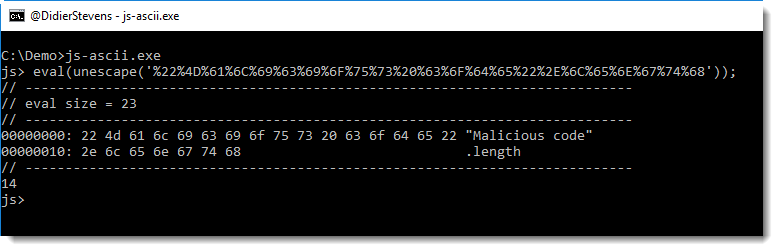
The ASCII/HEX dump allows me to see exactly, at the byte-level, what is passed as argument to eval.
js-1.7.0-mod-c.zip (https)
MD5: B14B522E81366D6AAF3B7EB235B62707
SHA256: 2CCB2F57DF706A8EE689C54B18A0EA7BB052EF08BA233F1319119825DB32927B
Tuesday 17 April 2018

Update: hash.py Version 0.0.3

Filed under: My Software,Update — Didier Stevens @ 0:00

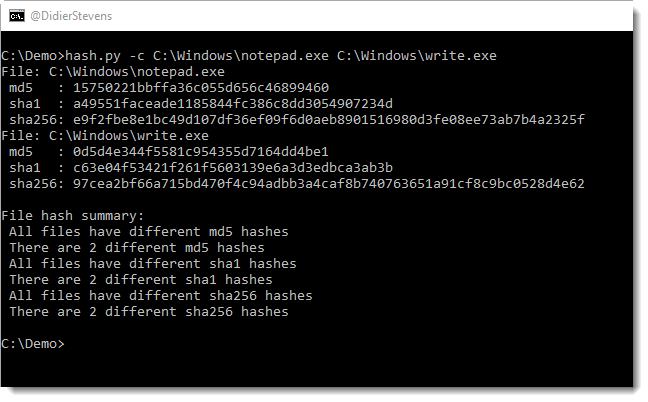
This new version of hash.py brings a small change to the output for option -c and adds option -s to skip specified hashes.

hash_V0_0_3.zip (https)
MD5: CB4BCB40CA50ED23AC7E47510B308811
SHA256: 6C3C44C5B98C7C7415E332D15B6EA887CD54170DADDDC726B3544F1696F4E324

« Previous PageNext Page »

Blog at WordPress.com.