This update to my Prefetch File 010 Template adds Sections A through D.

PFTemplate_V0_0_2.zip (https)
MD5: 56A98A78BD4E8D1AED88385AF1DD8446
SHA256: E15D721E46FFB8158C6D14C9A38DE4E3DD5DCD0972896441DF17590C540DBCC3
This update to my Prefetch File 010 Template adds Sections A through D.
PFTemplate_V0_0_2.zip (https)
MD5: 56A98A78BD4E8D1AED88385AF1DD8446
SHA256: E15D721E46FFB8158C6D14C9A38DE4E3DD5DCD0972896441DF17590C540DBCC3
shinnai made an interesting comment when I released my tool to find contained files: he wanted to know if I could add a batch mode.
I guess this batch mode is interesting when you want to check if a large set of files contains a particular file. So I added this features and release it here.
Now you can provide more than one containing-file to find-file-in-file.py: you can just type several files, use wildcards and/or use at-files (@file). When you specify @filename, find-file-in-file.py will search in all the files listed in textfile filename (each file on a separate line).
When you provide only one file to search, then this new version will just work like the previous version.
But if you provide more than one file, then batch mode is enabled. In batch mode, the contained file is searched for in each containing file. If a (partial) match is found, it will be included in the report. If no match is found, no output is produced. If you want output even when no match is found, then use option verbose (-v).
Example for a bunch of MSI files:
find-file-in-file.py msi49.tmp *.msi

File: c8400.msi
003a7200 00005600 (100%)
Finished
File: Cisco_Jabber.msi
00295600 00001000 (18%)
00294a00 00000c00 (13%)
00296600 00003a00 (67%)
Finished
File msi49.tmp was found in only 2 MSI files.
find-file-in-file_v0_0_3.zip (https)
MD5: 8691158700079C786F6905F0CA0F32BC
SHA256: 84506CED140F309503E723831A9EFB99A8CC213532BEB56E00BC4BA5FE235797
This new version of the generic frame extraction tool (naft-gfe) can handle files (RAM dumps) that are too large to fit into memory.

Use option -b for buffered reads. By default, the file will be read and analyzed in blocks of 101MB (100MB buffer + 1MB overlap buffer).
Since the file is not read completely in memory, there is a possibility that some frames/packets are not completely read in memory. For example, a frame starts in the first block of 100MB, and ends in the second block of 100MB. The analysis routines would miss this frame.
To avoid this, the program reads the first block of 100MB (block A) plus an extra block of 1MB (block B). This block of 101MB (A + B) is analyzed. Then, the second block of 100MB (block C) is read, and the extra block B is prepended to block C for analysis (B + C). Hence the overlap buffer is analyzed twice, but packets are only extracted once from this buffer. This procedure is repeated for the complete file.
It is important that the overlap buffer is large enough to accommodate the largest possible frame or packet. That’s why by default, it is 1MB.
Use options -S and -O to choose your own size for buffer and overlap buffer.
I made a video of the Network Appliance Forensic Toolkit demo I gave at my local ISSA chapter.
Suspender is a DLL that suspends all threads of a process.
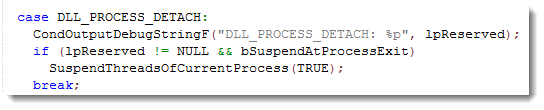
This new version adds an option to suspend a process when it exits. Rename the dll to suspenderx.dll to activate this option (x stands for eXit).
When DllMain is called with DLL_PROCESS_DETACH and the reserved argument is not NULL, the process is exiting. So that’s the trigger to suspend it.
Suspender_V0_0_0_4.zip (https)
MD5: 629255337FE0CA9F631B1A7177D158F0
SHA256: 8E63152620541314926878D01469E2E922298C147740BDEAF7FC6B70EB9305EF
I’ve been asked many times to support 32-bit keys with my XORSearch tool. But the problem is that a 32-bit bruteforce attack would take too much time.
Now I found a solution that doesn’t take months or years: a 32-bit dictionary attack.
I assume that the 32-bit XOR key is inside the file as a sequence of 4 consecutive bytes (MSB or LSB).
If you use the new option -k, XORSearch will perform a 32-bit dictionary attack to find the XOR key. The standard bruteforce attacks are disabled when you choose option -k.
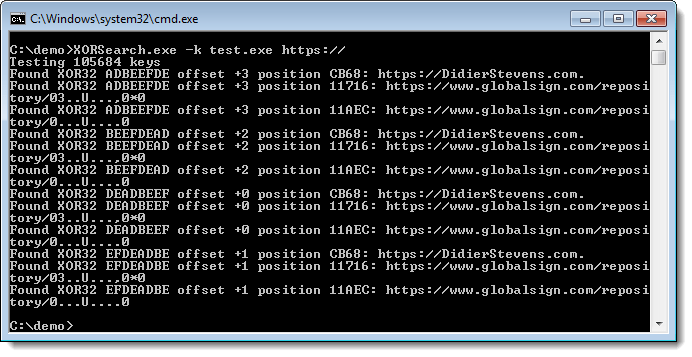
XORSearch will extract a list of keys from the file: all unique sequences of 4 consecutive bytes (MSB and LSB order). Key 0x00000000 is excluded. Then it will use this list of keys to perform an XOR dictionary attack on the file, searching for the string you provided. Each key will be tested with an offset of 0, 1, 2 and 3.
It is not unusual to find the 32-bit XOR key inside the file itself. If it is a self-decoding executable, it can contain an XOR x86 instruction with the 32-bit key as operand. Or if the original file contains a sequence of 0x00 bytes (4 consecutive 0x00 bytes at least), then the encoded file will also contain the 32-bit XOR key.
Here is a test where XORSearch.exe searches a 0xDEADBEEF XOR encoded copy of itself. With only 74KB, there are still 100000+ keys to test, taking almost 10 minutes on my machine:
XORSearch_V1_9_2.zip (https)
MD5: BF1AC6CAA325B6D1AF339B45782B8623
SHA256: 90793BEB9D429EF40458AE224117A90E6C4282DD1C9B0456E7E7148165B8EF32
Some time ago I had to figure out if a file was embedded inside another file.
It’s not a file carving problem. I had both files. I just needed to be sure that file A was contained inside file B.
With a hex editor I could find parts of file A inside file B, but it looked like file A was split up and scattered at different locations in file B.
I Googled a bit for a tool, but nothing came up, so I wrote my own Python program.
With my new tool I was able to get assured that file msi49.tmp was inside file c8400.msi:

You can see that file msi49.tmp is one contiguous sequence inside file c8400.msi starting at position 0x3A7200.
But I was more interested to know if file msi49.tmp was also inside file Cisco_Jabber.msi:

And you can see it is, but not as one contiguous sequence. It’s split in 3 sequences.
This tool can also be used to find a downloaded file inside a pcap/pcapng file. I downloaded AnalyzePESig_V0_0_0_2.zip while taking a Wireshark capture.

Or to find a file opened by an application. Here I look into the process dump:

The only limitation is that both files need to be read into memory. But when I’ve time, I’ll turn this into a plugin for the Volatility framework.
The program looks for sequences of at least 10 bytes long (this is an option). If your file is divided in sequences smaller than 10 bytes, then my program will not find the embedded file. Unless you lower the minimum length, but don’t go as low as 1 byte, because then you’re likely to be finding random data.
I’m not 100% sure that my program will find all possible cases of embedded files. No problem if it’s one contiguous sequence, or several sequences in logical order. But I’ve to review my algorithm to be sure it will also find all possible cases of embedded files with sequences in random order. I think it will, but I need to prove it.
find-file-in-file_v0_0_1.zip (https)
MD5: 2984F01404770B92953823D39907B055
SHA256: 1AD124A9A31DACFE1FC9F3B89B3117D3A70D5BC15B712CC1748BEA893612686C
Cookies set bij network proxies can be identified by their name.
BlueCoat proxy cookies start with BCSI-CS-.
Cisco IronPort proxy cookies start with iptac-. The string after iptac is the serial number of the device.
Google for these and you’ll find some examples.
More info later.
Soon I’ll release new versions of my Authenticode Tools.
Detecting extra data in the signature field is one of the new features. For example, it will analyze the size specified in the optional header data directory for security, the size specified in the WIN_CERTIFICATE structure and the size specified in the PKCS7 signature itself. These should be the same, taking into account some zero-byte padding.
In case you didn’t know: extra data can be added in the data directory that contains the signature, without invalidating the signature. My Disitool can do this.
With this new version of AnalyzePESig, I found some setup programs that contain extra data after the signature; data that seems to contain installation options for the installer. For example, the Google Chrome installer has this:

As you can see, the size specified in the optional header data directory for security and the size specified in the WIN_CERTIFICATE structure are both 6272 bytes, but the size of the PKCS7 signature is 6079. So that leaves 181 extra bytes. You can see them here:

And I found some other installers with extra data (config data or license information) in the signature directory: GotoMyPc, PowerGrep, RegexBuddy.
Microsoft’s Malware Protection Center has a blogpost on a version of Rovnix that uses its own TCP/IP stack.
I used Wireshark to capture the network traffic generated by this sample when it is executed in a VMware guest.
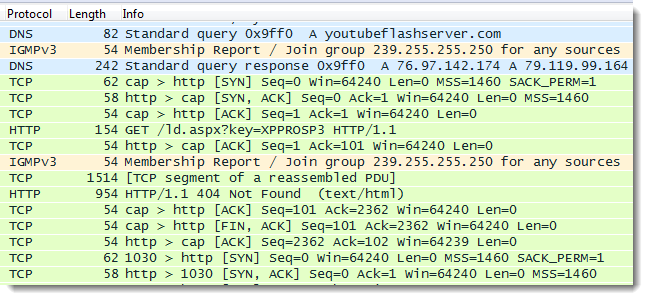
I ran the sample on a XP SP3 guest machine in VMware. The hostname is XPPROSP3 (this name will appear in the HTTP GET request).
The guest uses NAT.
I ran the Wireshark capture on my host machine on the VMware Virtual Ethernet Adapter.
I removed some traffic coming from my host machine (NetBIOS Name Service and DHCPv6 to be precise).
When I executed the sample on XPPROSP3, it rebooted after a few seconds.
The trace:
The 37 second gap between packet 6 and 7 is due to the reboot of XPPROSP3
Packet 44: DNS request for youtubeflashserver
There are 3 HTTP requests. Notice User-Agent FWVersionTestAgent in all 3 GET requests.
Packet 50: first GET request with hostname XPPROSP3 as a parameter. Response: 404
Packet 61: second GET request, malformed. Response: 400
Packet 70: third GET request, malformed. Response: 400
rovnix-capture-filtered.zip (https)
MD5: C941D1716B6248C3FBFB4DFFA8AD2E86
SHA256: 51EDA61199DD9EDC1E50C5A9B5A4B69F32DB74E90CF098849554C56217D06EFD

 Didier Stevens