This is just a small update to my XOR known-plaintext attack tool, with some improvements on the algorithm.
xor-kpa_V0_0_8.zip (http)MD5: EB6397FC81C920DF4E1753A4A31DA9B4
SHA256: 9706979A4B1FBC6E318F6015C69ED2759ADC871632FDB9034615A4488DAC32E0
This is just a small update to my XOR known-plaintext attack tool, with some improvements on the algorithm.
xor-kpa_V0_0_8.zip (http)This updates changes the THP_READALL logic, and adds THP_ECHO_THIS and THP_ALLOW_LIST.
simple_listener_v0_1_3.zip (http)This new versions adds 2 new features:
Option -H adds a human hash for each hash:

Option -r renames a file to its hash (hash) or to its hash with extension .vir (vir).
When more that one hash algorithm is used (default: md5, sha1, sha256), the last hash algorithm is used for the rename operation.

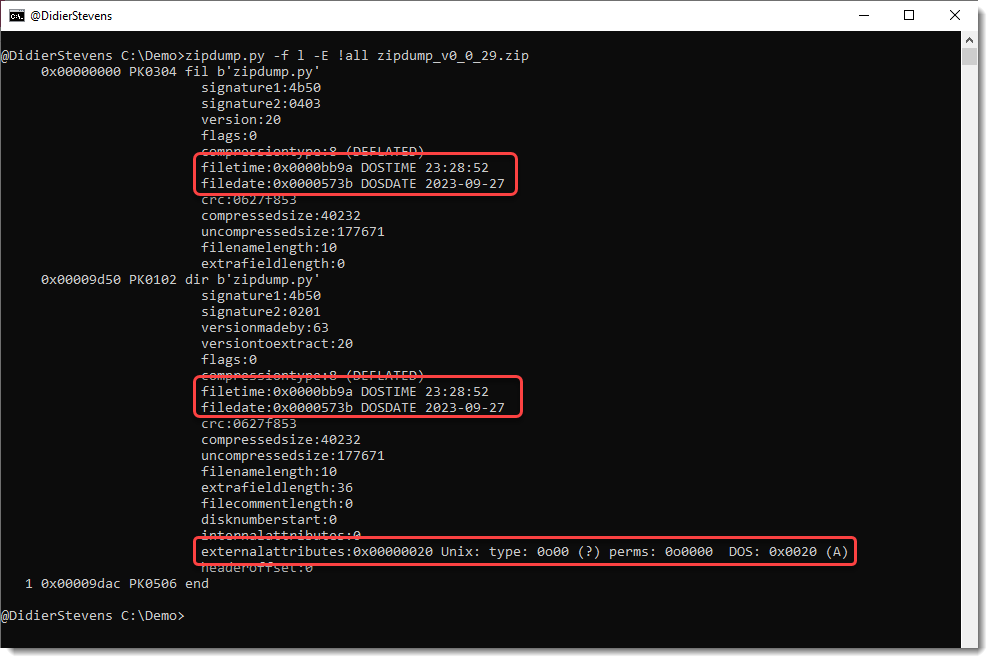
This update of zipdump.py adds parsing for external attributes and DOSDATE and DOSTIME fields when options -f and -E are used.

This update is just a definition update to detect MSO (ActiveMime files).
file-magic_V0_0_7.zip (http)This new update can produce JSON output for each part (option–jsonoutput).
emldump_V0_0_13.zip (http)This is an update linked to option -f l to find PKZIP records.
When option -E all is used, field externalattributes is parsed now:

Here is a YARA rule I developed to detect PDF/ActiveMime maldocs I wrote about in “Quickpost: Analysis of PDF/ActiveMime Polyglot Maldocs“.
It looks for files that start with %PDF- (this header can be obfuscated) and contain string QWN0aXZlTWlt (string ActiveMim in BASE64), possibly obfuscated with whitespace characters.
rule rule_pdf_activemime {
meta:
author = "Didier Stevens"
date = "2023/08/29"
version = "0.0.1"
samples = "5b677d297fb862c2d223973697479ee53a91d03073b14556f421b3d74f136b9d,098796e1b82c199ad226bff056b6310262b132f6d06930d3c254c57bdf548187,ef59d7038cfd565fd65bae12588810d5361df938244ebad33b71882dcf683058"
description = "look for files that start with %PDF- and contain BASE64 encoded string ActiveMim (QWN0aXZlTWlt), possibly obfuscated with extra whitespace characters"
usage = "if you don't have to care about YARA performance warnings, you can uncomment string $base64_ActiveMim0 and remove all other $base64_ActiveMim## strings"
strings:
$pdf = "%PDF-"
// $base64_ActiveMim0 = /[ \t\r\n]*Q[ \t\r\n]*W[ \t\r\n]*N[ \t\r\n]*0[ \t\r\n]*a[ \t\r\n]*X[ \t\r\n]*Z[ \t\r\n]*l[ \t\r\n]*T[ \t\r\n]*W[ \t\r\n]*l[ \t\r\n]*t/
$base64_ActiveMim1 = /Q [ \t\r\n]*W[ \t\r\n]*N[ \t\r\n]*0[ \t\r\n]*a[ \t\r\n]*X[ \t\r\n]*Z[ \t\r\n]*l[ \t\r\n]*T[ \t\r\n]*W[ \t\r\n]*l[ \t\r\n]*t/
$base64_ActiveMim2 = /Q \t[ \t\r\n]*W[ \t\r\n]*N[ \t\r\n]*0[ \t\r\n]*a[ \t\r\n]*X[ \t\r\n]*Z[ \t\r\n]*l[ \t\r\n]*T[ \t\r\n]*W[ \t\r\n]*l[ \t\r\n]*t/
$base64_ActiveMim3 = /Q \r[ \t\r\n]*W[ \t\r\n]*N[ \t\r\n]*0[ \t\r\n]*a[ \t\r\n]*X[ \t\r\n]*Z[ \t\r\n]*l[ \t\r\n]*T[ \t\r\n]*W[ \t\r\n]*l[ \t\r\n]*t/
$base64_ActiveMim4 = /Q \n[ \t\r\n]*W[ \t\r\n]*N[ \t\r\n]*0[ \t\r\n]*a[ \t\r\n]*X[ \t\r\n]*Z[ \t\r\n]*l[ \t\r\n]*T[ \t\r\n]*W[ \t\r\n]*l[ \t\r\n]*t/
$base64_ActiveMim5 = /Q\t [ \t\r\n]*W[ \t\r\n]*N[ \t\r\n]*0[ \t\r\n]*a[ \t\r\n]*X[ \t\r\n]*Z[ \t\r\n]*l[ \t\r\n]*T[ \t\r\n]*W[ \t\r\n]*l[ \t\r\n]*t/
$base64_ActiveMim6 = /Q\t\t[ \t\r\n]*W[ \t\r\n]*N[ \t\r\n]*0[ \t\r\n]*a[ \t\r\n]*X[ \t\r\n]*Z[ \t\r\n]*l[ \t\r\n]*T[ \t\r\n]*W[ \t\r\n]*l[ \t\r\n]*t/
$base64_ActiveMim7 = /Q\t\r[ \t\r\n]*W[ \t\r\n]*N[ \t\r\n]*0[ \t\r\n]*a[ \t\r\n]*X[ \t\r\n]*Z[ \t\r\n]*l[ \t\r\n]*T[ \t\r\n]*W[ \t\r\n]*l[ \t\r\n]*t/
$base64_ActiveMim8 = /Q\t\n[ \t\r\n]*W[ \t\r\n]*N[ \t\r\n]*0[ \t\r\n]*a[ \t\r\n]*X[ \t\r\n]*Z[ \t\r\n]*l[ \t\r\n]*T[ \t\r\n]*W[ \t\r\n]*l[ \t\r\n]*t/
$base64_ActiveMim9 = /Q\r [ \t\r\n]*W[ \t\r\n]*N[ \t\r\n]*0[ \t\r\n]*a[ \t\r\n]*X[ \t\r\n]*Z[ \t\r\n]*l[ \t\r\n]*T[ \t\r\n]*W[ \t\r\n]*l[ \t\r\n]*t/
$base64_ActiveMim10 = /Q\r\t[ \t\r\n]*W[ \t\r\n]*N[ \t\r\n]*0[ \t\r\n]*a[ \t\r\n]*X[ \t\r\n]*Z[ \t\r\n]*l[ \t\r\n]*T[ \t\r\n]*W[ \t\r\n]*l[ \t\r\n]*t/
$base64_ActiveMim11 = /Q\r\r[ \t\r\n]*W[ \t\r\n]*N[ \t\r\n]*0[ \t\r\n]*a[ \t\r\n]*X[ \t\r\n]*Z[ \t\r\n]*l[ \t\r\n]*T[ \t\r\n]*W[ \t\r\n]*l[ \t\r\n]*t/
$base64_ActiveMim12 = /Q\r\n[ \t\r\n]*W[ \t\r\n]*N[ \t\r\n]*0[ \t\r\n]*a[ \t\r\n]*X[ \t\r\n]*Z[ \t\r\n]*l[ \t\r\n]*T[ \t\r\n]*W[ \t\r\n]*l[ \t\r\n]*t/
$base64_ActiveMim13 = /Q\n [ \t\r\n]*W[ \t\r\n]*N[ \t\r\n]*0[ \t\r\n]*a[ \t\r\n]*X[ \t\r\n]*Z[ \t\r\n]*l[ \t\r\n]*T[ \t\r\n]*W[ \t\r\n]*l[ \t\r\n]*t/
$base64_ActiveMim14 = /Q\n\t[ \t\r\n]*W[ \t\r\n]*N[ \t\r\n]*0[ \t\r\n]*a[ \t\r\n]*X[ \t\r\n]*Z[ \t\r\n]*l[ \t\r\n]*T[ \t\r\n]*W[ \t\r\n]*l[ \t\r\n]*t/
$base64_ActiveMim15 = /Q\n\r[ \t\r\n]*W[ \t\r\n]*N[ \t\r\n]*0[ \t\r\n]*a[ \t\r\n]*X[ \t\r\n]*Z[ \t\r\n]*l[ \t\r\n]*T[ \t\r\n]*W[ \t\r\n]*l[ \t\r\n]*t/
$base64_ActiveMim16 = /Q\n\n[ \t\r\n]*W[ \t\r\n]*N[ \t\r\n]*0[ \t\r\n]*a[ \t\r\n]*X[ \t\r\n]*Z[ \t\r\n]*l[ \t\r\n]*T[ \t\r\n]*W[ \t\r\n]*l[ \t\r\n]*t/
$base64_ActiveMim17 = /QW [ \t\r\n]*N[ \t\r\n]*0[ \t\r\n]*a[ \t\r\n]*X[ \t\r\n]*Z[ \t\r\n]*l[ \t\r\n]*T[ \t\r\n]*W[ \t\r\n]*l[ \t\r\n]*t/
$base64_ActiveMim18 = /QW\t[ \t\r\n]*N[ \t\r\n]*0[ \t\r\n]*a[ \t\r\n]*X[ \t\r\n]*Z[ \t\r\n]*l[ \t\r\n]*T[ \t\r\n]*W[ \t\r\n]*l[ \t\r\n]*t/
$base64_ActiveMim19 = /QW\r[ \t\r\n]*N[ \t\r\n]*0[ \t\r\n]*a[ \t\r\n]*X[ \t\r\n]*Z[ \t\r\n]*l[ \t\r\n]*T[ \t\r\n]*W[ \t\r\n]*l[ \t\r\n]*t/
$base64_ActiveMim20 = /QW\n[ \t\r\n]*N[ \t\r\n]*0[ \t\r\n]*a[ \t\r\n]*X[ \t\r\n]*Z[ \t\r\n]*l[ \t\r\n]*T[ \t\r\n]*W[ \t\r\n]*l[ \t\r\n]*t/
$base64_ActiveMim21 = /QWN[ \t\r\n]*0[ \t\r\n]*a[ \t\r\n]*X[ \t\r\n]*Z[ \t\r\n]*l[ \t\r\n]*T[ \t\r\n]*W[ \t\r\n]*l[ \t\r\n]*t/
condition:
$pdf at 0 and any of ($base64_ActiveMim*)
}
The regex used to detect characters QWN0aXZlTWlt interspersed with whitespace characters (YARA string $base64_ActiveMim0) has no atoms (for YARA’s Aho-Corasic algorithm) larger than 1 byte, and thus generates a warning, that prohibits its use for hunting with VirusTotal.
That is why I replaced that regex with 21 regexes that all start with 3 fixed bytes and thus allow YARA to select atoms that are large enough.